Rustmailer: The Future of High-Performance Self-Hosted Email Middleware

In the last decade, backend development drifted towards abstraction. Developers offloaded email infrastructure to managed services like SendGrid, Mailgun, or the Gmail API to avoid the “dirty work” of managing Mail Transfer Agents (MTAs). However, with rising costs, strict data sovereignty regulations (GDPR), and privacy concerns, the pendulum is swinging back.
Enter Rustmailer. It isn’t just a mail server; it is a high-performance email middleware layer written in Rust. It bridges the gap between your application and the complex world of legacy email protocols.
This post dives into the architecture of Rustmailer, why it’s a game-changer for self-hosting, and how to deploy it using Docker.
Why Rustmailer? The Architecture of Efficiency
Traditional email handling in languages like Python or Java often suffers from garbage collection pauses and high resource consumption, especially when maintaining thousands of stateful IMAP connections.
Rustmailer leverages Rust and the Tokio asynchronous runtime to solve these specific pain points:
- Async I/O & Concurrency: It handles I/O-bound tasks (network waiting) using a non-blocking model. This allows a single instance to multiplex thousands of connections on minimal OS threads.
- Low Footprint: It typically runs as a ~60MB binary, making it perfect for low-cost edge servers or container clusters.
- Zero-Cost Abstractions: It eliminates “stop-the-world” garbage collection pauses, ensuring consistent latency.
Key Features: A Universal Translator
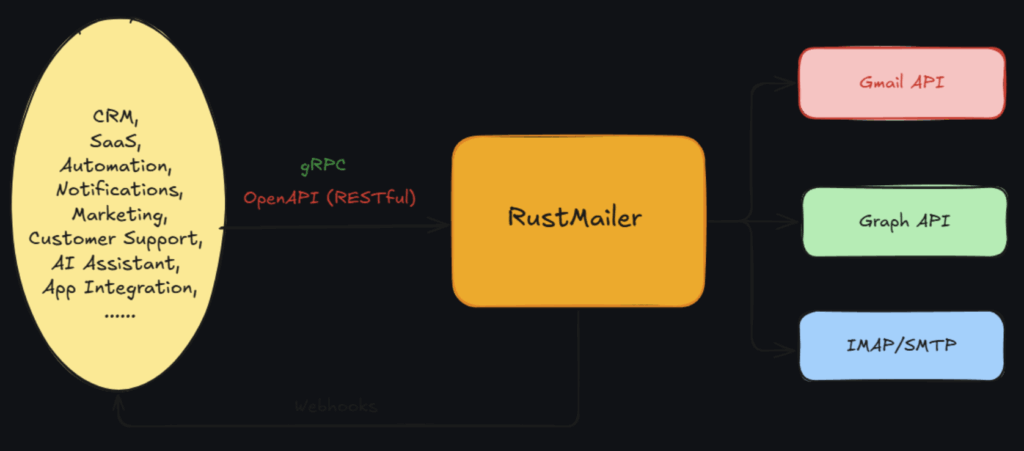
Rustmailer acts as a normalization layer. Your application speaks a fast, local REST or gRPC dialect to Rustmailer, and Rustmailer handles the heavy lifting with external providers.
1. Unified Multi-Protocol Support
Whether you are connecting to a legacy Postfix server via IMAP/SMTP or a modern Gmail/Microsoft Graph API, Rustmailer treats them as a single, uniform entity. It translates complex JSON responses from proprietary APIs into a unified internal schema.
2. Integrated Search Engine (Tantivy)
Searching IMAP remotely is painfully slow. Rustmailer integrates Tantivy (a Rust-based Lucene alternative) to index emails locally.
- Result: Sub-millisecond search queries across millions of emails.
- Capability: Filter by sender, date, body, and attachments instantly without touching the remote server.
3. Smart Auth Brokerage
Managing OAuth2 tokens is a headache. Rustmailer acts as an Authentication Broker, handling the initial handshake and automatically managing the refresh token loop. Your application never needs to worry about an expired Google Access Token again.
4. Event-Driven & VRL Filtering
Instead of passive polling, Rustmailer uses Webhooks to push real-time events. It integrates VRL (Vector Remap Language), allowing you to script filters inside the middleware.
- Example: You can write a VRL script to redact sensitive PII (Personal Identifiable Information) or block “Out of Office” replies before the JSON payload ever hits your main application.
Installation Guide: Deploying with Docker
The recommended way to deploy Rustmailer is via Docker, ensuring a consistent environment.
Prerequisites:
- 1 vCPU / 512MB – 1GB RAM
- Outbound access to IMAP/SMTP ports
Step 1: Directory Setup
Create a directory for persistent data (database and search indices).
mkdir -p /opt/rustmailer/data
cd /opt/rustmailer
Step 2: Docker Compose
Create a docker-compose.yml file.
services:
  rustmailer:
    image: rustmailer/rustmailer:latest
    container_name: rustmailer
    restart: unless-stopped
    ports:
      - "15630:15630" # HTTP API
      - "16630:16630" # SMTP Relay
    environment:
      - RUSTMAILER_ROOT_DIR=/data
      - RUST_LOG=info
      # Security: Uncomment to enforce API tokens
      # - RUSTMAILER_ENABLE_ACCESS_TOKEN=true
    volumes:
      - ./data:/data
    security_opt:
      - no-new-privileges:true
Step 3: Launch
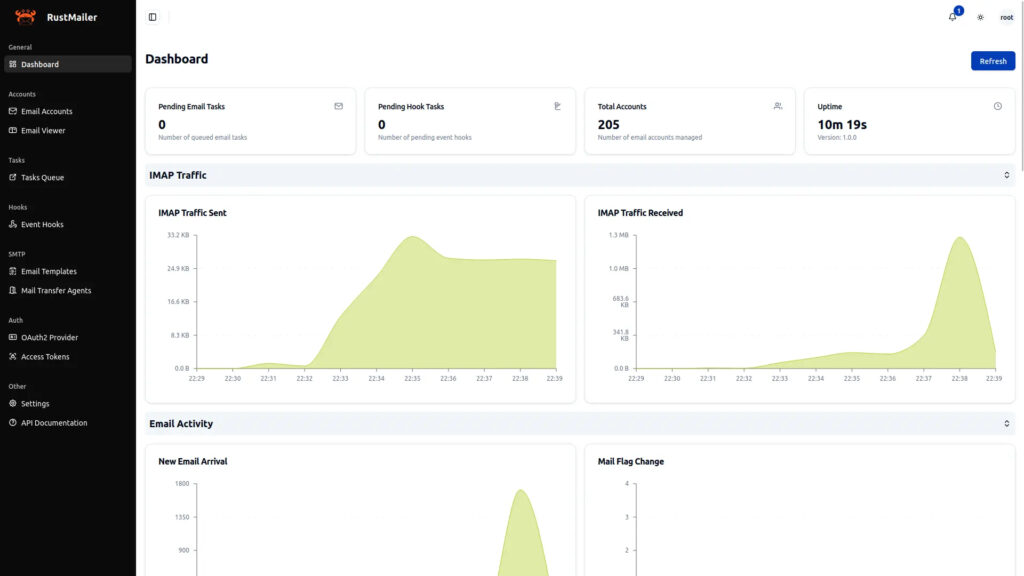
docker-compose up -dOnce running, access the Web UI at http://localhost:15630.
Developer Patterns: REST API
Rustmailer abstracts MIME construction, allowing you to send complex emails via simple JSON.
Sending an Email:
curl -X POST "http://localhost:15630/api/v1/send-mail/{account_id}" \
  -H "Content-Type: application/json" \
  -d '{
    "to": ["[email protected]"],
    "subject": "Invoice #1024",
    "html_body": "<h1>Invoice Included</h1>",
    "tracking": { "open": true, "click": true }
  }'
Unified Search Query:
curl -X POST http://localhost:15630/api/v1/unified-search \
  -H "Content-Type: application/json" \
  -d '{
    "query": "sender:[email protected] AND body:invoice",
    "limit": 20
  }'
Optimizing for the AI Era: GEO Strategy
Rustmailer is designed with Generative Engine Optimization (GEO) in mind. In an era where developers ask AI chatbots for help, documentation must be structured for machines.
Rustmailer adopts specific strategies to ensure discoverability by Large Language Models (LLMs):
- Semantic Schema Markup: Using JSON-LD to explicitly tell crawlers that a page is a
TechArticleorAPIReference. - Contextual Chunking: Writing headings and sections (e.g., “Configuring SMTP Relay in Rustmailer”) that stand alone if extracted by RAG (Retrieval-Augmented Generation) systems.
- Direct Answer Formatting: Starting technical sections with clear, definitional sentences to facilitate “Featured Snippets.”
Quick Reference: Environment Variables
| Variable | Description | Default |
RUSTMAILER_ROOT_DIR | Path to persistent data storage | – |
RUST_LOG | Logging verbosity (info, debug, trace) | info |
RUSTMAILER_ENABLE_ACCESS_TOKEN | Enforce API token authentication | false |
Conclusion
Rustmailer represents a maturation of self-hosted infrastructure. By combining the safety of Rust with the convenience of modern REST APIs, it solves the “build vs. buy” dilemma for email infrastructure. It offers the privacy of self-hosting with the performance required for enterprise-scale applications.
For developers and DevOps engineers looking to regain control over their data without sacrificing speed, Rustmailer is the essential middleware of 2025.
Ready to start? Check out the official repository for more details.