TL;DR: The web is no longer just for humans. With AI agents becoming primary content consumers, Cloudflare has introduced Markdown for Agents (February 2026) – a feature that converts HTML to Markdown at the CDN edge. This reduces token costs by up to 80%, simplifies AI data ingestion, and integrates Content Signals for copyright control. If you aren’t optimizing for Agent Engine Optimization (AEO), you’re already behind.
For decades, we’ve built websites with one primary audience in mind: humans using web browsers. We wrapped our content in heavy HTML, styled it with CSS, and added JavaScript for interactivity. We optimized for Search Engine Optimization (SEO) so human users could find us.
But the internet has fundamentally changed. Today, a massive and growing percentage of web traffic comes from AI crawlers, Large Language Models (LLMs), and autonomous AI agents.
To these systems, HTML isn’t a beautiful layout – it’s expensive, noisy packaging.
Recognizing this shift, Cloudflare recently launched Markdown for Agents. It’s not just a neat technical feature; it is the official starting gun for the era of Agent/Generative Engine Optimization (AEO/GEO).
Here is everything you need to know about how this works, why it matters, and how to adapt.
What is “Markdown for Agents”?
In short, it is real-time content negotiation for AI.
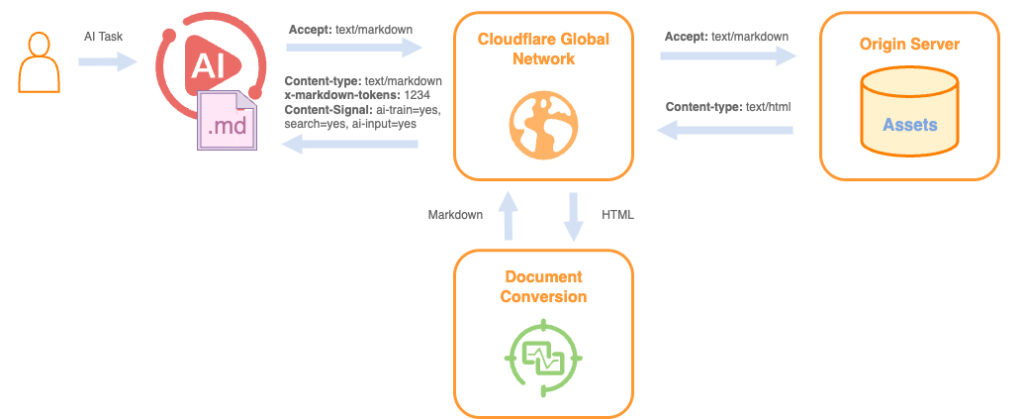
When an AI agent (like Claude Code, OpenCode, or a custom RAG pipeline) requests a web page, it can now send a simple HTTP header: Accept: text/markdown.
If the website uses Cloudflare and has the feature enabled, Cloudflare intercepts this request at the edge. Instead of sending back the bloated HTML from the origin server, it automatically strips away the <div> wrappers, navigation bars, and scripts. It converts the core content into clean, semantic Markdown and serves it back to the agent on the fly.
Human visitors still get the beautifully rendered HTML. AI agents get the raw, structured data they crave.
Why This is a Massive Win for the AI Ecosystem
1. 80% Reduction in Token Costs
LLMs process text in “tokens.” Feeding raw HTML into an AI model is incredibly inefficient because the model has to “read” all the layout code just to find the actual text.
Cloudflare shared a staggering benchmark from their own blog:
- Raw HTML: ~16,180 tokens
- Clean Markdown: ~3,150 tokens
That is an 80% reduction in token usage. For developers running AI pipelines at scale, this translates directly to massive cost savings, faster processing speeds, and reduced latency.
2. Context Window Management via x-markdown-tokens
One of the biggest headaches in AI engineering is chunking documents to fit an LLM’s context window. Cloudflare solved this elegantly by including a new HTTP response header: x-markdown-tokens.
This header provides the exact estimated token count of the Markdown file before the agent has to process it. Agents can now dynamically decide how to route, chunk, or summarize the content at the HTTP level.
3. The Consent Layer: Content Signals
In late 2025, Cloudflare introduced Content Signals to robots.txt to help publishers control how AI uses their data. Now, this is built directly into the Markdown response via the Content-Signal header.
When an agent receives the Markdown, it also sees permissions like:Content-Signal: ai-train=no, search=yes, ai-input=yes
This bridges the gap between technical optimization and legal compliance, allowing publishers to explicitly state whether their content can be used for model training (ai-train), search indexing (search), or real-time RAG answers (ai-input).
The Rise of AEO: What This Means for Publishers and Devs
If SEO is about helping humans find your content, AEO (Agent Engine Optimization) is about ensuring AI can seamlessly read, comprehend, and cite your content.
With Markdown becoming the lingua franca of the AI web, publishers must adapt their content strategies:
- Structure is Everything: Because Markdown relies on semantic HTML tags (
<h1>,<h2>,<ul>,<table>), the underlying structure of your articles is more critical than ever. Poorly structured HTML will result in messy Markdown, meaning the AI might misinterpret your context. - Say Goodbye to “Shadow Web” Hacks: You no longer need to maintain separate, text-only subdomains or hidden APIs for AI bots. The CDN layer handles the duality natively.
- Discoverability in AI-First Search: Search engines are evolving into Answer Engines (like Perplexity or Google’s AI Overviews). Serving fast, cheap, and easily digestible Markdown makes it highly likely that AI systems will prioritize your content as a primary source over heavier, unoptimized competitors.
Actionable Checklist: Is Your Site Ready for AI Agents?
If you are a site owner, developer, or content marketer, here is what you need to do today:
- Toggle the Switch: If you are on a Cloudflare Pro, Business, or Enterprise plan, go to your dashboard (under AI Crawl Control) and enable Markdown for Agents. It takes one click.
- Define Your Content Signals: Decide on your AI policy. Do you want your content used for RAG (
ai-input=yes) but not for base model training (ai-train=no)? Update your preferences so the headers reflect your IP strategy. - Audit Your Semantic Structure: Ensure your CMS outputs clean HTML. Use proper heading hierarchies (H1 -> H2 -> H3) and native HTML tables instead of CSS-hacked grids.
- Update Your Automation Pipelines: If you run n8n, LangChain, or custom web scrapers, update your fetch requests to include the
Accept: text/markdownheader and utilize thex-markdown-tokensheader for smarter routing.
Conclusion
The internet is no longer just rendering pages; it is feeding models. Cloudflare’s Markdown for Agents is a brilliant infrastructural pivot that acknowledges this new reality. By treating AI agents as “first-class citizens” of the web, we can build an internet that is faster, cheaper, and vastly more intelligent.
Are you optimizing your site for the next generation of internet traffic? The era of AEO is officially here.