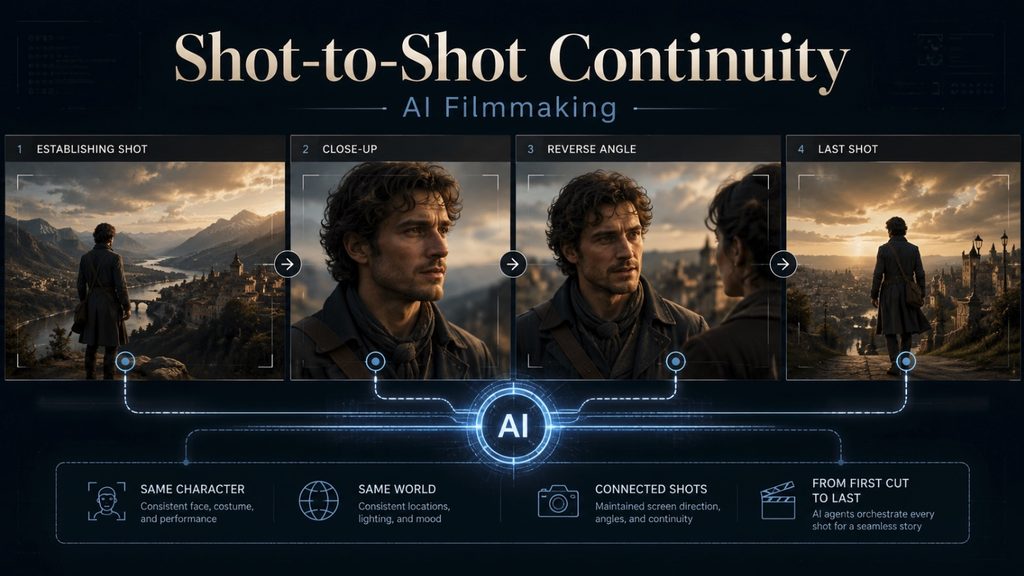
AI filmmaking is helping creators solve one of the biggest challenges in AI video production: keeping every shot connected. By remembering characters, locations, lighting, camera choices, and creative rules, modern AI workflows can maintain continuity across scenes. The goal is not to replace filmmakers but to support their decisions with systems that understand the full project.
Why is shot-to-shot continuity difficult in AI filmmaking?
Creating one impressive AI-generated clip is becoming easier. Creating an entire sequence where every shot feels like part of the same film is much harder.
AI filmmaking solves shot-to-shot continuity by using project memory, references, and creative rules to keep characters, locations, camera styles, and visual details consistent across scenes. Instead of generating every clip separately, continuity-focused AI workflows understand the wider story and apply existing decisions to new shots.
In traditional filmmaking, continuity is managed through detailed planning, production notes, costume tracking, set references, and the work of continuity supervisors. A filmmaker knows that a small change can break immersion. A character wearing a different jacket between two connected shots or a room changing layout without explanation can distract viewers.
AI-generated videos face a similar challenge. Many AI tools create individual clips based only on the current instruction. This can cause changes in character appearance, lighting, camera movement, and scene details.
The solution is moving toward AI systems that understand a complete production instead of a single prompt. These systems can remember creative choices and help filmmakers maintain a consistent visual language throughout the project.
A continuity-focused workflow can track:
- Character appearance and wardrobe
- Locations and environment details
- Lighting style and colour treatment
- Camera movement and framing choices
- Story rules that affect future scenes
This makes AI video production closer to a real filmmaking process where every department works from the same creative vision.
How does AI maintain continuity across a complete film?
AI maintains continuity by storing important project information and applying it when creating new scenes. This allows each shot to follow decisions made earlier in production.
A filmmaker may define a character’s appearance, decide that a scene uses handheld camera movement, or establish a specific lighting style. Without memory, AI may treat every new shot as a fresh request.
With project context, the AI system can use previous information as a foundation.
The invideo Agent filmmaking workflow remembers scripts, character sheets, locations, and references so creative decisions remain consistent across shots, scenes, and episodes.
This changes the role of AI from a simple generation assistant into a creative collaborator. The filmmaker still controls the story, but the AI helps manage the details that need to stay consistent.
For larger projects, this becomes even more important. A short film, series, or brand film may include dozens of scenes created over multiple sessions. Keeping the same creative rules throughout prevents the project from becoming visually disconnected.
Is character consistency part of AI filmmaking continuity?
Yes, character consistency is one of the most important parts of AI filmmaking continuity because viewers connect stories through recognizable characters.
Character consistency means keeping a character’s appearance, clothing, expressions, and story state stable across different shots. AI systems can support this by using character references and stored project information during generation.
A character should look the same whether the camera shows a wide shot, close-up, or action scene. The same applies to changes that happen naturally during a story.
For example, if a character removes a jacket during a scene, future shots need to understand that change. If a character gets injured, the visual details need to continue correctly in later scenes.
AI workflows can manage this through character sheets and reference material. These resources define important details before production begins.
Character sheets can capture multiple views, expressions, and story changes such as wardrobe updates or physical changes during a sequence.
This becomes especially useful for episodic content, where characters may appear across many scenes and episodes.
Does AI keep lighting and camera style consistent?
AI can maintain lighting and camera style by using creative rules established for a project. This helps every shot feel like it belongs to the same visual world.
Lighting and camera consistency are maintained when AI understands the visual language of a project. This includes choices like colour tone, camera movement, framing style, and the mood created by lighting.
A filmmaker may decide that a thriller uses dark lighting, handheld movement, and close framing. A comedy may use brighter colours, wider shots, and smoother camera movement.
If these choices change randomly between shots, the audience feels the difference.
AI filmmaking systems are becoming better at carrying these rules from one generation to another. Instead of explaining the camera style repeatedly, creators can define the approach once and use it throughout production.
Invideo Agent supports this type of workflow by keeping project context connected across the creative process. It can maintain information about locations, lighting choices, and camera direction while working with different models for different shots. The invideo Agent can route shots to more than 200 models depending on the creative requirement.
This allows creators to focus on directing decisions rather than managing every technical setting.
Can AI create match cuts and reverse angles correctly?
AI can support match cuts and reverse angles when it understands the relationship between connected shots.
Match cuts and reverse angles work when AI tracks spatial details such as character position, movement direction, camera placement, and environment layout. Continuity-aware workflows help preserve these relationships so edits feel natural.
A match cut depends on a visual connection between two shots. A reverse angle depends on keeping the scene geography correct.
For example, in a conversation scene, the camera may move from one character to another. The characters need to remain positioned correctly, and the lighting should remain consistent.
AI-generated scenes can struggle when every shot is created independently. The system may change the room layout or move characters without following the previous scene.
A continuity-based workflow solves this by using previous shots as references. The AI can understand what has already happened and create the next shot based on that information.
Invideo Agent maintains shot-to-shot continuity for projects, including characters, locations, lighting, camera style, and screen direction. It uses this information when generating new shots instead of treating each generation as separate.
This approach helps filmmakers build sequences where individual shots connect naturally.
How does agentic AI change AI filmmaking workflows?
Agentic AI changes filmmaking by helping manage the full creative process instead of handling only one task.
Agentic AI works like a creative team that can understand project goals, remember decisions, and support different stages of production. It helps with planning, generation, review, and refinement while keeping the filmmaker in control.
A filmmaking project includes many connected tasks. Writers develop the story, directors plan scenes, cinematographers define visual style, and editors shape the final sequence.
AI agents can support these different roles through shared project information.
Invideo Agent works as an AI filmmaking collaborator that helps creators move from ideas and references to complete video projects. It supports development, pre-visualisation, continuity, creative direction, AI VFX, and editing workflows.
The advantage comes from shared context. A storyboard decision can influence shot generation. A character decision can guide future scenes. An editing choice can connect back to the original creative plan.
The recent launch of invideo Agent Two introduces a frontier intelligence agent built for serious creative work. It can understand project conversations, read different formats such as scripts, PDFs, videos, and links, and connect information across different creative tasks without requiring repeated explanations.
This type of workflow helps creators spend more time making creative decisions and less time managing disconnected production steps. Similar AI agent workflows are also being explored in other creative and business areas, where specialized AI systems help teams handle tasks such as planning, content creation, and campaign execution. For example, businesses looking to understand how AI agents can support marketing workflows can explore this guide on AI marketing agents for small businesses.
Building a reliable AI filmmaking process
A strong AI filmmaking workflow starts with planning. The more clearly a project defines its creative rules, the easier it becomes to maintain consistency.
A practical workflow includes:
- Creating character references before generating scenes
- Defining locations and visual style
- Establishing camera and lighting rules
- Reviewing generated shots as sequences
- Refining the final edit with the full project context
Editing also plays an important role. Generated clips still need pacing, transitions, sound, and creative adjustments.
Context-aware editing tools can help because they already understand the script, shot plan, and approved footage. Slate, the editing workspace inside invideo Agent, uses project context including scripts, shot breakdowns, generated clips, and approved takes to help creators assemble and refine videos.
This creates a connected workflow where planning, generation, and editing work together.
Conclusion
AI filmmaking is changing how creators approach shot-to-shot continuity. Instead of generating isolated clips, modern AI workflows can remember characters, locations, lighting choices, and camera styles across a complete project. The biggest improvement comes from treating AI as a creative partner.
As AI video tools continue to improve, filmmakers can focus more on storytelling, direction, and creative choices. The future of AI filmmaking will not only be about generating images and videos. It will be about creating complete visual worlds that stay consistent from beginning to end.
How do you think AI will change the way filmmakers handle continuity in future productions?
Frequently Asked Questions
What is shot-to-shot continuity in AI filmmaking?
Shot-to-shot continuity means keeping connected scenes visually and logically consistent. In AI filmmaking, this includes maintaining characters, locations, lighting, camera movement, and other creative details across multiple generated shots.
Why does AI-generated video struggle with continuity?
AI-generated video can struggle with continuity because many systems create clips independently. Without project memory, details such as character appearance, environment, and camera style may change between scenes.
Can AI keep the same character across multiple scenes?
Yes, AI can maintain character consistency by using references, character sheets, and stored project information. These details help future generations follow established character rules.
Can AI filmmaking maintain the same camera style?
Yes, AI filmmaking workflows can maintain camera style by remembering choices such as movement, framing, and visual direction. This helps create a consistent look across scenes.
How does agentic AI help filmmakers?
Agentic AI helps filmmakers by understanding project goals, remembering creative decisions, and supporting different production tasks. It can assist with planning, generation, editing, and continuity management.
Can AI help create longer films and series?
Yes. AI workflows with project memory can support longer projects such as films, series, and microdramas by keeping characters, locations, and creative rules consistent across multiple scenes.