Key Takeaways: waoowaoo is a self-hosted, Docker-based AI production platform that takes raw novel text as input and outputs a fully assembled short drama video – complete with characters, scenes, storyboard shots, and synthesized voiceover – without requiring any dedicated production software or manual editing.
What Is waoowaoo?
waoowaoo AI Studio is an open-source AI agent platform designed to automate the end-to-end production pipeline for short drama and comic video content. It targets the growing category of short-form narrative video – the kind produced for streaming platforms, social media, and online drama series – and applies AI at every stage of the workflow, from parsing source text to composing the final video output.
The project describes itself as an industry-first professional AI agent platform for controllable film and video production, covering everything from short-form content to live-action productions following Hollywood-standard workflows. It is currently in early public beta, actively developed, and ships as a fully containerized stack that can be running locally in three commands.
The platform supports a bilingual interface in both Chinese and English, reflecting its origins in a market where AI-generated short drama content has become a significant production category.
How the Production Pipeline Works
waoowaoo structures video production as a sequential AI agent pipeline, where each stage feeds directly into the next. The entire chain can be triggered from a single input: the source text of a novel or script.
AI Script Analysis
The first stage parses the input text – a novel chapter, a script draft, or a narrative outline – and extracts structured data: named characters, scene descriptions, plot beats, and dialogue. This analysis produces the foundation that all subsequent stages draw from. Rather than requiring the user to manually decompose a story into production assets, the AI agent handles the interpretation and structuring automatically.
Character and Scene Generation
Using the extracted character and scene data, waoowaoo generates visual assets using connected image generation models. The system is designed to maintain character consistency across shots – a critical requirement for narrative video that distinguishes waoowaoo from generic image generation pipelines. Characters look the same across different scenes, and scene environments maintain visual coherence with the established setting.
The recommended image generation backends are ByteDance Volcano Engine (Seedream) and Google AI Studio, which are configured through the Settings panel after deployment.
Storyboard Assembly and Video Composition
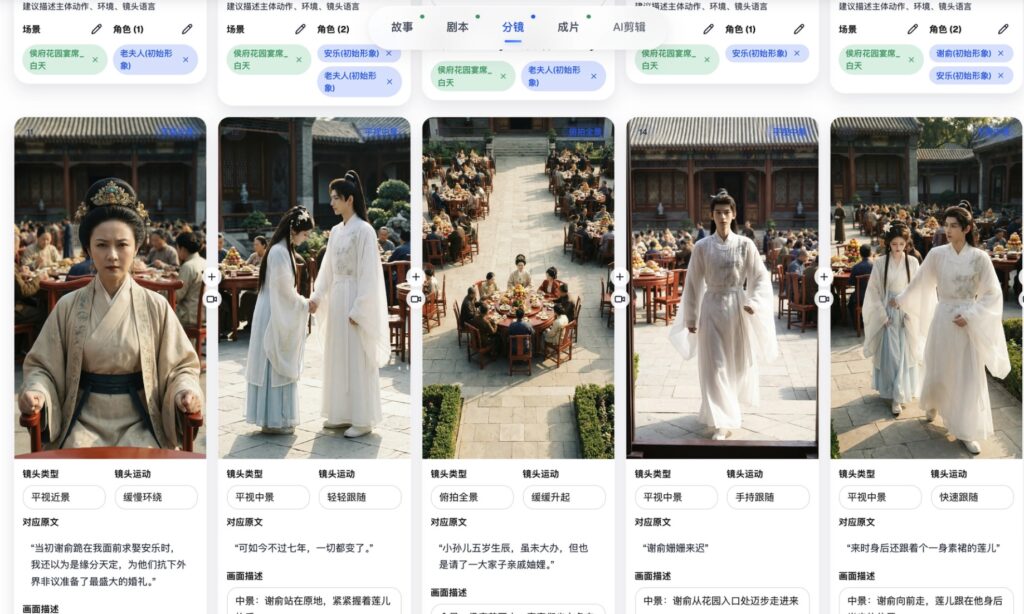
With characters and scenes generated, the platform automatically composes storyboard shots and assembles them into a sequential video. This stage handles the shot-by-shot structure of the output – determining the order, duration, and composition of each frame – and produces a complete video output from the assembled materials. The Seedance model from ByteDance Volcano Engine is the primary recommended backend for video generation.
AI Voiceover
The final stage adds multi-character voice synthesis to the assembled video. Each character in the extracted cast receives a distinct synthesized voice, and the dialogue identified during script analysis is assigned and rendered accordingly. The result is a fully voiced video production generated entirely from the original text input.
Installation Guide
Prerequisites
waoowaoo requires only Docker Desktop to run. No local Node.js environment, no database installation, and no manual service configuration are needed. The entire stack – Next.js application, MySQL database, Redis queue, and all supporting services – is managed by Docker Compose.
Quick Start with Docker
git clone https://github.com/saturndec/waoowaoo.git
cd waoowaoo
docker compose up -d
Once the containers are running, open a browser and navigate to:
http://localhost:13000The MySQL database initializes automatically on the first launch. No additional database setup or migration commands are required.
Enabling HTTPS with Caddy
Running in HTTP mode can limit browser connection concurrency, which may cause noticeable lag during media-heavy generation tasks. To enable HTTPS locally, install Caddy and run:
caddy run --config CaddyfileThen access the interface at:
https://localhost:1443The Caddyfile is included in the repository root and is pre-configured for the local HTTPS setup.
Updating to the Latest Version
Since the project is in active early development with frequent updates, staying current is straightforward:
git pull
docker compose down && docker compose up -d --build
This pulls the latest code, rebuilds the Docker images, and restarts all services while preserving the existing database state.
API Configuration
Connecting AI Providers
After launching the interface, navigate to Settings to configure the AI service API keys. A built-in configuration guide is provided within the Settings panel.
The following providers are officially tested and recommended:
- ByteDance Volcano Engine – provides the Seedance model for video generation and the Seedream model for image generation. This is the primary recommended backend for both visual stages of the pipeline.
- Google AI Studio – provides Gemini-based image generation models as an alternative visual backend.
- OpenRouter – required for text model access. Script analysis and narrative extraction currently route through OpenRouter-compatible language models.
API keys for each provider are entered through the Settings UI and stored in the local database. The built-in guide within Settings walks through obtaining each key from the respective provider dashboards.
Using waoowaoo
Once API keys are configured, the core workflow follows a straightforward sequence:
Begin by creating a new project and pasting or importing the source novel text or script. The AI Script Analysis agent processes the input and returns a structured breakdown of characters, scenes, and plot beats for review. Users can inspect and adjust the extracted data before proceeding.
With the script analysis confirmed, trigger character and scene generation. The platform generates consistent visual assets for each character and setting identified in the analysis stage. These assets can be reviewed and regenerated individually if the output does not match the intended visual direction.
Once the visual assets are approved, initiate storyboard and video assembly. The platform composes the shot sequence and assembles the video from the generated materials. The AI Voiceover stage can then be run against the assembled video to add character dialogue.
The final output is a complete short drama video ready for review, download, or further post-production.
Use Cases
waoowaoo addresses a specific and growing production category – AI-assisted short-form narrative video – but its pipeline architecture makes it applicable across several adjacent use cases:
- Web novel and light novel adaptation: Source text from online fiction platforms can be fed directly into the pipeline, making it practical for content studios adapting serialized fiction into episodic short drama series.
- Manga and comic storyboarding: The character consistency system and storyboard assembly stage can serve as a rapid visual development tool for comic adaptation projects, generating visual references for each scene before committing to final artwork.
- Indie film pre-production: Independent filmmakers can use the storyboard generation pipeline as a low-cost previsualization tool – generating a rough visual assembly of scenes from a script before shooting begins.
- Educational content production: Instructional content creators working with narrative formats can use the voiceover and scene generation pipeline to produce illustrated video lessons from written course material.
- Localized short drama content: The bilingual Chinese-English interface and support for Chinese-language source text make waoowaoo directly usable for the large-scale short drama production workflows common in Chinese streaming markets.
Development and Extension Ideas
waoowaoo is in early beta and explicitly welcomes feature requests through its GitHub Issues tracker. Several natural directions for extending the platform emerge from its current architecture:
- Additional image generation backends: The current tested backends are Seedream and Google AI Studio. Adding support for locally hosted image generation models (such as ComfyUI or Stable Diffusion via API) would allow fully offline production pipelines without external API costs.
- Custom voice model integration: Connecting the voiceover stage to locally hosted TTS models or commercial voice cloning services would give productions more precise control over character voice identity.
- Scene-level editing interface: A timeline or scene editor that allows reordering, replacing, or regenerating individual shots without rerunning the full pipeline would significantly improve iterative production workflows.
- Subtitle and caption generation: Automatically generating time-aligned subtitles from the voiceover output would make the platform more directly useful for distribution on captioned video platforms.
- Multi-episode project management: A project structure that supports organizing multiple episodes within a single series, sharing character assets and settings across episodes, would make the platform viable for serialized production at scale.
- Export pipeline integration: Direct export to video editing applications via standard formats or project exchange files would allow waoowaoo to function as the pre-production stage of a broader professional pipeline.
Tech Stack
waoowaoo is built on a modern JavaScript full-stack architecture:
| Layer | Technology |
|---|---|
| Frontend Framework | Next.js 15 + React 19 |
| Database | MySQL + Prisma ORM |
| Job Queue | Redis + BullMQ |
| Styling | Tailwind CSS v4 |
| Authentication | NextAuth.js |
| Reverse Proxy (optional) | Caddy |
| Deployment | Docker + Docker Compose |
The job queue architecture using Redis and BullMQ is particularly significant: AI generation tasks – image creation, video assembly, voiceover synthesis – are long-running operations that the queue manages asynchronously, allowing the interface to remain responsive while generation jobs process in the background.
Conclusion
waoowaoo occupies a genuinely novel position in the AI tooling landscape. It is not a general-purpose image or video generator – it is a purpose-built production pipeline that treats the complete journey from written story to assembled video as a single, automatable workflow. For content creators working in short drama, web novel adaptation, or AI-assisted film pre-production, that end-to-end scope is what makes it worth running.
The project is early, actively developed, and self-hosted by design. For teams that want full control over a novel-to-video production pipeline without relying on proprietary platforms or per-generation pricing, waoowaoo is among the most complete open-source options available today.
- Repository: https://github.com/waoowaooAI/waoowaoo
- Docker Desktop: https://docs.docker.com/get-docker/
- Caddy (HTTPS): https://caddyserver.com/docs/install
- ByteDance Volcano Engine: https://www.volcengine.com/
- OpenRouter: https://openrouter.ai/
- License: Open-source (early beta)