AutoGPT is the open source AI framework that turns raw LLMs into self-directed, continuously running autonomous AI agents you can actually deploy.
AutoGPT’s mission in the agent era
AutoGPT began as one of the first open source autonomous AI agents that wraps GPT‑4 and similar models, allowing them to decompose a user goal into sub‑tasks and execute tools like web browsing and file operations without constant human prompting.
Today, the AutoGPT project positions itself as a platform to “democratize AI,” aiming to give individuals and small businesses access to powerful digital assistants that run continuously, not just chatbots you type into.
AutoGPT’s core mission is to make autonomous AI agents practical: predictable behavior, continuous operation, and low‑code workflows so both hobbyists and enterprises can build self‑hosted AI agents, not just call an API.
That shift—from experimental script to open source AI framework and cloud platform—defines how you should think about AutoGPT in 2026.
From single script to AutoGPT ecosystem
In its first wave, AutoGPT was a Python script you ran locally: you gave it a name, role, and a few goals; it looped through “thought → action → observation” using an LLM and a set of tools.
As usage exploded, the maintainers evolved it into a layered ecosystem: a classic agent, the Forge for building new agents, a Benchmark suite to measure performance, and a frontend/UI on top.
The AutoGPT Forge acts as a comprehensive template and toolkit for building your own agents, bundling the agent code, a benchmarking system, and an optional frontend into a single developer experience.
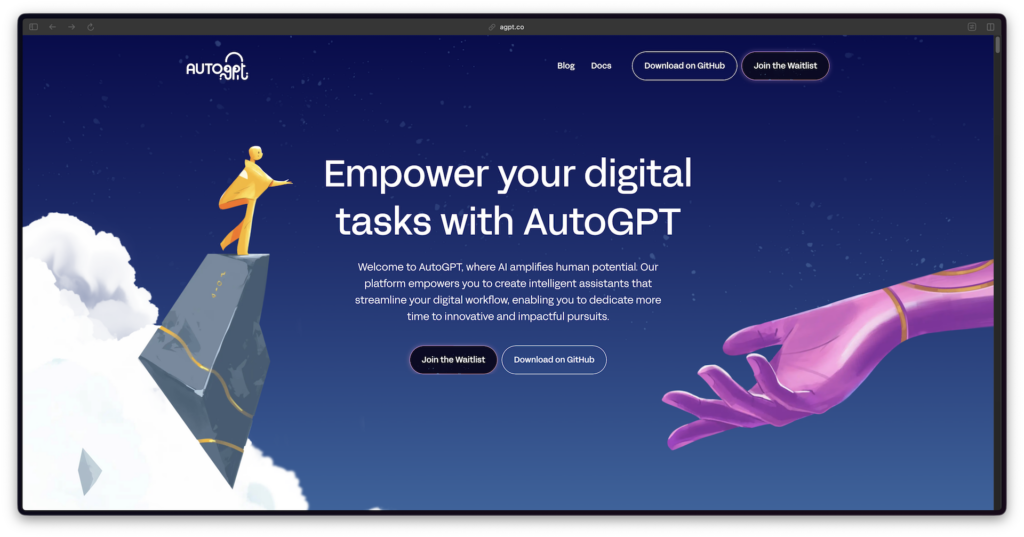
On top of that, the team now offers the AutoGPT Platform, a cloud environment where agents run continuously with a low‑code workflow builder, targeted at small businesses and enterprise workloads.
Architecture: agent, Forge, Benchmark, UI
AutoGPT agent core
At the center is the AutoGPT agent: a loop that uses an LLM (OpenAI GPT‑4/3.5 and others) to plan steps, select tools, execute actions (HTTP, file I/O, shell, etc.), and update its internal state until a goal is reached.
Unlike a manual LLM chat where you provide every instruction, AutoGPT orchestrates self‑prompting, task decomposition, and tool selection to behave like a self‑directed problem solver.
Forge: framework for new agents
The Forge is the “builder” layer: a structured agent template, supporting code, and scripts that guide you through setting up, extending, and running your own AutoGPT‑based agent.
It brings together the agent core, the Benchmark tests, and the UI, acting as the starting point when you want a custom autonomous AI agent instead of only the stock one.
Benchmark: evaluating agent performance
The Benchmark component is a curated suite of tasks—organized as a tree of challenges in the UI—that your agent can run to measure capabilities and regressions.
From the Forge UI you can open the Benchmark view (often indicated by a trophy icon), select categories of challenges, and watch live pass/fail status as your agent executes them.
Frontend & AutoGPT Platform UI
For classic, self‑hosted setups, the Forge tutorial and related guides describe a browser UI served locally (for example at http://localhost:8000/) where you can log in and send tasks to your agent without touching a terminal.
The hosted AutoGPT Platform extends this with a low‑code interface to connect agents and tools, configure continuous cloud‑hosted agents, and expose business‑ready workflows for non‑developers.
Prerequisites and environment
AutoGPT is intentionally opinionated about its environment so autonomous AI agents behave predictably across machines and teams.
Python, LLMs, and keys
- Python 3.10+ – The classic AutoGPT agent and Forge are written in Python and require at least Python 3.10 on Linux, macOS, or WSL2 on Windows.
- OpenAI (or other) LLM API key – Official guides assume an OpenAI API key, which you must create in the OpenAI dashboard and paste into your
.envfile asOPENAI_API_KEY. - Git – Needed to clone the AutoGPT repository and keep up with updates.
You can plug in alternative LLM providers via environment variables and configuration files, but the “happy path” for most autonomous AI agents still starts with OpenAI models.
Docker for isolation and reliability
The maintainers explicitly recommend Docker (and Docker Compose) for running AutoGPT, especially in production or shared environments.
Docker gives you an isolated container with pinned dependencies and built‑in services like Redis, which are otherwise tedious to manage locally.
If you plan to run self‑hosted AI agents on a server or NAS, treat the Docker‑based deployment as the default AutoGPT installation guide rather than installing everything directly on the host.
AutoGPT installation guide
Option 1: Docker‑based deployment (recommended)
This path is ideal for both secure experimentation and production‑grade, self‑hosted AI agents.
- Clone the repository
git clone https://github.com/Significant-Gravitas/AutoGPT.git
cd AutoGPT
Guides for the modern platform typically expect you to work inside the platform/backend folder (for example autogpt_platform/backend or similar) when running Docker Compose commands.
- Prepare environment configuration
Most tutorials start by copying the example environment file so you can set API keys and service URLs:
cp .env.example .envFor classic agent setups the docs instead point you to original_autogpt/ and .env.template, which you copy to .env before editing.
- Start the platform stack with Docker Compose
A common pattern from recent AutoGPT platform guides is:
cd autogpt_platform
cp .env.example .env  # if not done already
docker compose up -d --build
This boots backend services (API, worker queue, Redis, etc.) and exposes the web UI, typically on http://localhost:8000/ for local development.
- Access the UI and log in
Once containers are healthy, navigate to the frontend URL, log in with your preferred identity provider (such as GitHub or Google), and you can start creating tasks or workflows for your autonomous AI agents through the browser.
Docker also makes it straightforward to keep your deployment up to date: pulling the latest image and re‑running docker compose up -d is usually enough for a self‑hosted AI agent stack upgrade.
Option 2: Local Git + Python (classic agent)
If you want full control of the Python environment or to hack deeply on the agent loop, the classic setup runs directly on your machine.
- Clone AutoGPT and enter the classic agent folder
git clone https://github.com/Significant-Gravitas/AutoGPT.git
cd AutoGPT/original_autogpt
The docs explain that original_autogpt/ contains the classic agent implementation and configuration.
- Create your
.envfile and set API keys
cp .env.template .envOpen .env in a text editor, locate OPENAI_API_KEY=, and paste your key after the equals sign with no quotes or spaces; add any other provider or tool keys you intend to use.
- Install dependencies
Many guides still use pip against a requirements.txt file:
pip install -r requirements.txtSome newer docs use Poetry instead, but the idea is the same: install Python dependencies for the agent, tools, and memory backends.
- Run the classic agent
You can start AutoGPT in interactive mode via the Python module entry point:
python -m autogptHosted tutorials and docs describe a similar flow: the module starts, prompts you for agent configuration, then enters the think/act loop as you approve actions.
For quick scripts, there are also helper launchers like ./run.sh (Linux/macOS) and .\run.bat (Windows) that wrap python -m autogpt with sensible defaults.
Configuring your first autonomous AI agent
When you launch the classic AutoGPT agent, it asks you to define the agent’s name, role, and objective, often with support for several sub‑goals.
Under the hood, this becomes the “profile” for the autonomous AI agent, informing how it plans tasks, chooses tools, and evaluates when it has succeeded.
A simple workflow many tutorials show is:
- Provide a descriptive name like
MARKET_RESEARCH_PROand a role such as “an AI analyst that researches SaaS competitors.” - Specify one high‑level objective plus up to several sub‑objectives (e.g., “compile a CSV of top 20 competitors, key pricing tiers, and differentiating features”).
From there, AutoGPT starts the loop of “thoughts, reasoning, plan, criticism, next action,” prompting you at each step unless you switch to continuous mode.
Continuous mode vs manual authorization
By default, AutoGPT runs in an interactive mode where each proposed command is shown to you, and you choose whether to approve it one step at a time or for N steps.
Typical flows let you enter y for a single command, y -10 to approve ten steps in a row, provide natural language feedback, or exit the agent loop entirely.
Continuous Mode removes that safety rail:
python -m autogpt --continuousIn continuous mode, the agent immediately executes any command the LLM proposes without asking for confirmation, which security researchers have warned can lead to unbounded behavior and large API bills if misconfigured.
You should reserve continuous mode for tightly sandboxed environments (for example, dedicated Docker containers with constrained file system and network access) and well‑tested agents, especially when running self‑hosted AI agents in production.
Capabilities deep dive: browsing, memory, filesystem
Internet browsing and external tools
AutoGPT can integrate web browsing and HTTP tools so the agent can search, scrape, and reason over online content as part of its plan.
Guides and deep dives highlight how the agent uses browsing to expand context—fetching documentation, market data, and examples before writing code or reports in later steps.
In a typical autonomous AI agent workflow, browsing is just another tool in the toolbox: the LLM decides when to trigger it, how to parse the results, and when to persist findings into memory for future steps.
Memory backends: Local, Redis, Pinecone, and more
AutoGPT separates short‑term context (conversation history in the prompt) from long‑term memory stored in dedicated backends.
The official memory configuration docs list several backends controlled by the MEMORY_BACKEND variable in .env, including local (JSON file), redis, and vector databases like Pinecone, Milvus, and Weaviate.
A typical Redis setup—especially when using Docker Compose—looks like:
# .env
MEMORY_BACKEND=redis
REDIS_HOST=localhost
REDIS_PORT=6379
REDIS_PASSWORD=your_strong_password
Docker Compose–based installs of AutoGPT generally include a Redis service out of the box, so you can enable persistent memory without extra infrastructure.
For large‑scale, production‑level autonomous AI agents, Pinecone and similar vector databases provide scalable long‑term memory at the cost of additional cloud complexity and careful cost management.
File system and artifact management
AutoGPT agents commonly use file tools to read, write, and modify files in a working directory—generating reports, CSVs, code, and logs as they pursue their goals.
Deep‑dive traces show the agent iteratively writing code, reading it back, running tests, and creating final artifacts such as README.md and export files before signaling that goals are accomplished.
For security, you should mount a dedicated workspace directory into the container (or process) and restrict what the agent can access; in production, treat these mounts as ephemeral sandboxes with explicit export pipelines for safe artifacts.
AutoGPT vs manual LLM usage
Conceptually, “AutoGPT vs manual LLM” mirrors the difference between scripting and using a REPL:
- With a manual LLM (e.g., ChatGPT or raw API), you are the planner—breaking work into steps, deciding when to call tools, and stitching outputs together.
- With AutoGPT, the LLM‑powered agent becomes the planner: it self‑prompts, decomposes tasks, calls tools, and iterates until objectives are met, while you mainly define the goal, constraints, and environment.
This makes AutoGPT and its Forge particularly attractive as an open source AI framework for autonomous AI agents that must run for hours or days, orchestrate multiple tools, and maintain long‑term memory—capabilities that are awkward to build by hand around a single chat completion endpoint.
For many teams, the pragmatic approach is hybrid: prototype flows manually in a notebook or chat interface, then encode the successful patterns into an AutoGPT Forge agent, wire it into the Benchmark suite, and deploy it via Docker as a self‑hosted AI agent or on the AutoGPT Platform for continuous cloud operation.
Treat this AutoGPT installation guide as your foundation: once you can reliably run, observe, and benchmark your agents, you can start layering in domain tools, enterprise observability, and advanced memory strategies to push autonomous AI agents into real production systems.