Picture this: 80,000 fans packed into a roaring stadium, eyes darting between the pitch and the massive screens blazing with color along every sideline. The energy is electric, the attention is total, and every brand displayed on those LED panels is burning itself into the memory of tens of thousands of engaged spectators. Few advertising environments on earth can match that intensity.
Football stadium LED screens have transformed how brands connect with audiences at live events. Gone are the static banners and painted hoardings of the past — today’s perimeter displays and giant video boards deliver dynamic, high-resolution content that shifts in real time, keeping pace with the action on the field and the conversation on social media.
For advertising agencies, however, the challenge is clear: clients demand maximum visibility and measurable returns, but budgets are finite. Finding outdoor advertising solutions that combine broadcast-quality performance with genuine cost efficiency is a constant pressure. This article examines exactly how football stadium LED screens answer that challenge — breaking down the technology, the economics, and the strategic opportunities that make them one of the most compelling tools available for large-scale, high-impact campaigns today.
Understanding Football Stadium LED Screens and Advertising Impact
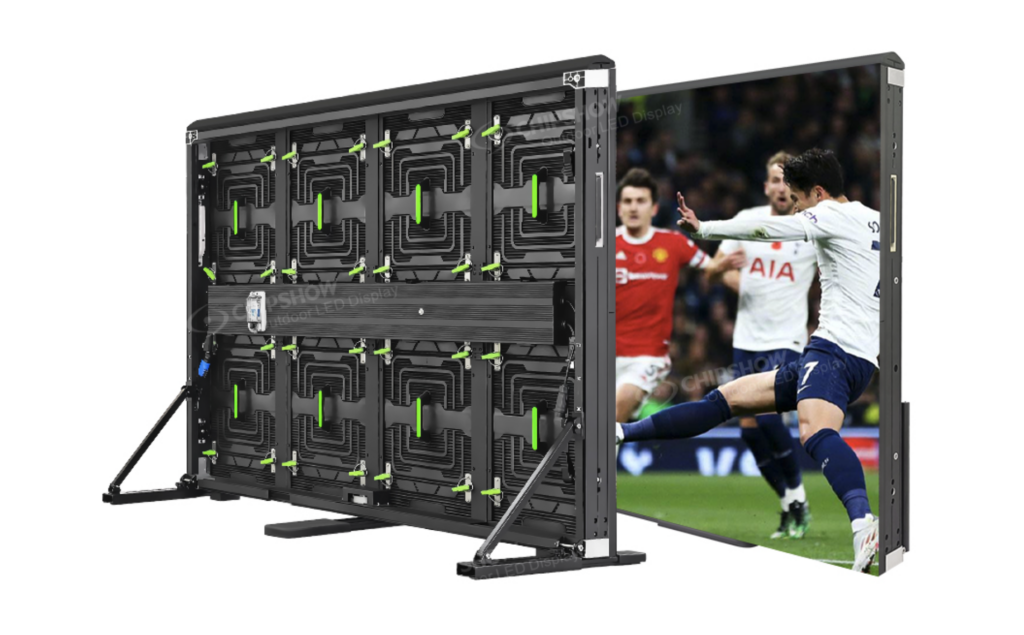
Football stadium LED screens are large-format digital display systems installed throughout sports venues — spanning perimeter boards that ring the pitch, giant scoreboards and video walls visible from every seat, and ribbon displays wrapping the stadium tiers. Their primary function has shifted well beyond showing replays. Today, they are central to the commercial architecture of modern football, turning every match into a live advertising event reaching tens of thousands of in-person spectators and millions more watching on broadcast.
The transition from static advertising to dynamic LED displays represents one of the most significant shifts in sports marketing over the past two decades. Traditional painted hoardings and vinyl banners offered fixed messages with zero flexibility — a brand bought space and held it for a season, regardless of whether the moment was right. LED screens shattered that model entirely. Advertisers can now rotate multiple brands within a single match, trigger contextual messages tied to on-field events, and update creative in real time based on audience demographics or sponsor agreements.
For brand visibility, the impact is measurable and substantial. Research consistently shows that dynamic digital content captures attention far more effectively than static formats, with higher recall rates among audiences. In a stadium environment, where emotional engagement is already elevated, that effect is amplified. Fans in a heightened state of excitement are significantly more receptive to brand messaging, making football stadium LED screens one of the highest-engagement advertising placements available in outdoor media today.
High Brightness LED Displays: Essential for Outdoor Advertising Success
Visibility is everything in stadium advertising. A beautifully designed creative means nothing if it washes out under afternoon sunlight or loses contrast during a floodlit night match. This is why brightness — measured in nits — sits at the top of every serious buyer’s specification list. High-quality football stadium LED screens typically operate at 6,000 to 10,000 nits for outdoor perimeter boards, ensuring crisp, saturated imagery regardless of ambient light conditions. Lower-tier alternatives often struggle above 3,000 nits, producing visibly faded content during daytime fixtures — a costly compromise for any brand paying premium rates for pitch-side placement.
Pixel pitch is equally critical. Tighter pixel pitch means higher resolution at closer viewing distances, but for large stadium displays viewed from 50 to 200 meters, a pitch between 6mm and 10mm typically delivers the optimal balance of image clarity and cost efficiency. Choosing the wrong specification in either direction means either overspending on resolution that spectators cannot perceive or deploying displays that look pixelated on broadcast cameras — undermining the very exposure brands are paying for.
Technical Specifications and Durability Features
Outdoor stadium environments are punishing. Displays must withstand rain, temperature swings, humidity, and the occasional impact from errant balls or maintenance equipment. Leading outdoor LED panels carry IP65 or higher ingress protection ratings, sealing internal components against dust and water intrusion. Robust aluminum cabinet construction resists corrosion while keeping weight manageable for structural mounting. Equally important is thermal management — efficient heat dissipation systems extend component lifespan significantly, reducing maintenance frequency. Suppliers such as Chipshow LED have built their stadium product lines around exactly these durability benchmarks, reflecting how central long-term reliability has become to the purchasing decision. Well-specified displays routinely achieve 100,000-hour operational lifespans, meaning a stadium investing today can expect reliable performance across many seasons without major hardware overhauls.
Cost-Effective Solutions: Maximizing ROI with Stadium LED Screens
The economics of stadium LED advertising become compelling the moment you move beyond the upfront cost and examine the full picture. Traditional billboard campaigns lock budgets into fixed creative for weeks or months, while television spots demand repeated production cycles and media buys that escalate quickly. Stadium LED screens operate on an entirely different model — one installation supports dozens of advertisers across a single season, with content updates requiring nothing more than a file upload. That structural flexibility fundamentally changes the cost-per-exposure calculation.
Energy efficiency compounds the financial case. Modern LED technology consumes significantly less power than legacy lighting systems, and the operational savings over a multi-year deployment are substantial. Combined with the extended hardware lifespan discussed earlier, the total cost of ownership for a well-specified LED system proves far lower than the initial investment suggests. Stadiums that have made the transition consistently report that the ability to monetize screen time across multiple sponsors within a single fixture dramatically accelerates return on infrastructure investment.
Comparing Costs with Other Advertising Channels
When advertising agencies stack stadium LED placements against comparable channels, the numbers are instructive. Television advertising during live sports commands premium CPM rates — often the highest in any media category — yet the viewer is at home, distracted, and one remote click away from disengagement. Out-of-home billboards deliver passive impressions from commuters whose attention is divided. Stadium LED screens, by contrast, reach audiences who have physically committed to being present, are emotionally invested in the event, and are surrounded by an environment that reinforces brand association with excitement and competition. Engagement rates and recall scores in stadium settings consistently outperform both formats. For agencies managing large-scale campaigns where measurable impact justifies spend, that combination of reach, emotional context, and operational flexibility makes stadium LED advertising one of the strongest ROI propositions in the current media landscape.
For Advertising Agencies: Leveraging LED Screens for Innovative Campaigns
The technical capabilities of modern stadium LED screens open creative territory that simply didn’t exist a decade ago. For advertising agencies, the real competitive advantage lies not just in securing screen time, but in designing campaigns that exploit the medium’s full potential. Real-time content triggers are among the most powerful tools available — imagine a sports drink brand’s creative automatically switching to a high-energy celebration visual the moment the home team scores, or a betting platform displaying live odds that update with every significant match event. These contextually aware executions feel native to the environment rather than interrupting it, which drives substantially stronger audience response.
Integration with broader digital campaigns multiplies impact considerably. Stadium LED content can be synchronized with concurrent social media pushes, encouraging fans to engage with branded hashtags displayed on-screen and extending the campaign’s reach far beyond the physical venue. Second-screen behavior — fans simultaneously watching the match and scrolling their phones — creates a genuine bridge between the live environment and digital channels. Agencies that build campaigns treating the stadium screen as one node in a connected ecosystem, rather than a standalone placement, consistently see stronger overall performance metrics.
Creative Strategies and Campaign Integration
Consider a hypothetical campaign for an automotive brand at a top-flight fixture: perimeter LED boards display a dynamic teaser during pre-match warmups, the giant video screen runs a 30-second brand film during halftime, and pitch-side boards show a targeted call-to-action during the final whistle — all while a synchronized Instagram campaign invites fans to share their match-day experience tagged with the brand. Each touchpoint reinforces the others. Sponsorship integration takes this further still; naming rights to in-stadium moments — the goal-of-the-match replay, the player ratings graphic — embed the brand into content fans are actively seeking out rather than passively tolerating. For agencies pitching innovative LED solutions, framing stadium screens as a live, programmable media environment rather than a traditional outdoor format is the strategic shift that unlocks their genuine value.
Implementation Guide: Practical Steps to Adopt Football Stadium LED Screens
Translating the strategic case for stadium LED advertising into an actual running campaign requires methodical groundwork. Agencies that skip steps early tend to encounter avoidable problems — mismatched content specs, budget overruns, or placements that underperform because the wrong venues were selected. Following a structured implementation process protects both the campaign and the client relationship.
Step-by-Step Action Plan
1. Research and select stadium partners. Begin by mapping venues against your target audience demographics. A regional brand benefits little from a stadium whose fanbase skews toward a different geography. Verify that prospective venues operate modern, high-brightness LED infrastructure — request technical specifications upfront and confirm broadcast coverage if earned media exposure is part of the brief. Avoid venues running outdated displays that will compromise creative quality.
2. Assess technical requirements and content specifications. Each stadium’s display system has defined content parameters: aspect ratios, file formats, resolution requirements, and refresh rate constraints. Collect these specs before briefing your creative team. Designing content that doesn’t conform to the hardware wastes production budget and causes last-minute scrambles. Confirm whether real-time content triggers or live data feeds are supported, as these capabilities shape what campaign executions are actually feasible.
3. Budget and negotiate strategically. Stadium operators typically offer tiered packages — perimeter boards, halftime video slots, and premium pitch-side placements carry different rate cards. Negotiate multi-fixture deals rather than single-match buys; volume commitments almost always unlock better rates. Factor content production and scheduling management into the total budget from the start rather than treating them as afterthoughts.
4. Design and schedule content for maximum impact. Match your content scheduling to the emotional rhythm of the fixture — pre-match anticipation, halftime attention peaks, and post-match euphoria each call for different creative approaches. Build contingency versions for different match scenarios where possible.
5. Measure effectiveness rigorously. Establish KPIs before launch: brand recall surveys, social media mention tracking, broadcast impression estimates, and direct response metrics where applicable. Post-campaign analysis should feed directly into the next brief, creating a continuous improvement loop that compounds campaign value over time.
Why Stadium LED Screens Belong in Every Agency’s Campaign Toolkit
Football stadium LED screens represent a genuine convergence of performance and commercial efficiency that few advertising formats can match. High-brightness displays ensure creative lands with full impact whether the sun is blazing at a Sunday afternoon fixture or floodlights are cutting through a midweek night match. Durable construction and extended operational lifespans keep total ownership costs well below what the initial investment might suggest. And the structural flexibility of the medium — rotating multiple brands, triggering contextual content, synchronizing with digital campaigns — delivers engagement depth that static outdoor formats and even broadcast spots struggle to replicate.
For advertising agencies navigating the constant pressure to deliver measurable returns on finite budgets, that combination is hard to argue against. Stadium LED screens don’t just reach audiences — they reach audiences who are physically present, emotionally activated, and surrounded by an environment that amplifies brand association in ways passive media channels cannot engineer.
The opportunity is clear. Agencies that move beyond treating stadium screens as a traditional outdoor buy and instead approach them as programmable, live media environments will unlock campaigns that outperform on recall, engagement, and ROI. If you haven’t yet explored football stadium LED screens as a core component of your large-scale campaign toolkit, now is the moment to start those conversations with venue partners and technology suppliers — before your competitors do.