Picture this: Your team has nailed the industrial design for a desktop busy-light that syncs with every major collaboration app. Early reviewers love it, the crowdfunding video is racking up pledges, and you have a pencilled-in ship date six months out.
Then the microcontroller you built the firmware around suddenly disappears from every authorized distributor. Lead time: 38 weeks—right in the middle of the average 28–40-week window many MCUs still suffer.
Cash burn keeps ticking, early-bird backers start asking for refunds, and your marketing momentum evaporates. In hardware, a single out-of-stock part can snowball into six months of delay and hundreds of thousands of dollars in opportunity cost.
The lesson is brutal but clear: clever design alone will not get your office gadget onto desks; disciplined component sourcing will.
The rest of this article maps the five sourcing milestones you must master if you want to ship on time—and stay solvent while doing it.
Map the Journey: Five Sourcing Milestones Between Idea and Ship Date
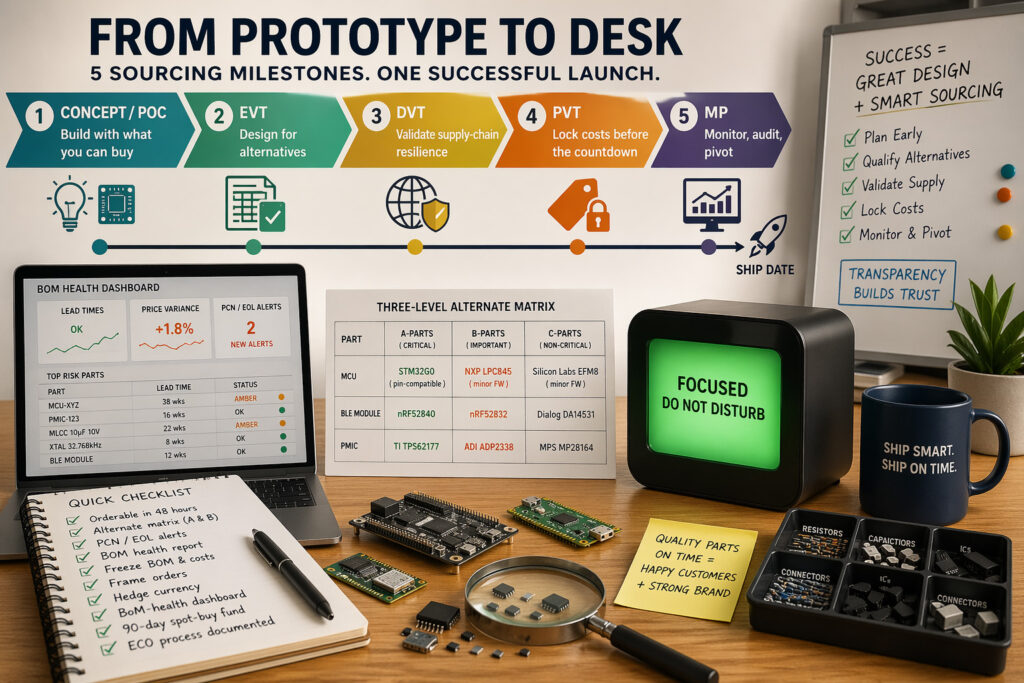
Office-gadget founders often underestimate how early sourcing decisions lock in—or limit—future options. The development path typically runs through five milestones:
- Concept / Proof-of-Concept (PoC) – whiteboards, dev boards, no commitments.
- Engineering Validation Test (EVT) – first custom PCBs, basic functional validation.
- Design Validation Test (DVT) – design frozen, units built on near-production tooling.
- Production Validation Test (PVT) – pilot run on the actual assembly line.
- Mass Production (MP) – volume build and sustained fulfilment.
As you move right on this timeline, design freedom shrinks while the cost of a change explodes. By DVT you’re effectively married to the Bill of Materials (BoM); swapping a core IC now ripples through PCB layout, firmware, compliance tests and enclosure tooling.
Understanding what must happen at each milestone—and when to freeze which parts—lets you bake sourcing discipline into the schedule instead of treating it as last-minute procurement.
Milestone 1 – Idea & Early Prototype: Build With What You Can Buy
At the PoC stage you’re proving product-market fit, not chasing the perfect spec sheet. That reality collides head-on with persistent lead-time pain: widespread parts still sit at 28–40 weeks.
Fighting the market is futile. Instead, prototype with components you can order today:
- Development boards & breakout modules – Arduino, Raspberry Pi Pico, ESP32, Feather, etc.
- Commercial sub-assemblies – pre-certified BLE or Wi-Fi modules, off-the-shelf LED drivers.
- Evaluation kits – vendor-supplied reference designs that include drivers and sample code.
Yes, the BOM cost will look ugly, but speed beats elegance right now. A functioning demo helps you validate UX assumptions, collect user feedback, and lock down industrial design dimensions.
It also aligns beautifully with the deep-work rhythm culture Luxafor explores in its article on deep-work rhythm—short, focused cycles trump protracted theorizing. When the concept proves sticky, you’ll rewrite the BOM for cost and scale during EVT.
Milestone 2 – EVT: Design for Alternatives, Not Favourites
EVT is where you graduate from Lego-style boards to your first real PCB. Tempting as it is to cherry-pick the MCU or sensor with the slickest datasheet, remember that supply volatility hasn’t vanished. AI data-centre buyers alone have driven GPU contract prices up 18% since Q4 2024.
That demand shock cascades down into power-management ICs, oscillators and passives.
Your countermeasure is a three-level alternate matrix:
- A-parts (Critical) – Pin-compatible drop-ins validated upfront.
- B-parts (Important) – Functionally equivalent parts requiring minor firmware tweaks.
- C-parts (Non-critical) – Value or tolerance shifts you can accept without redesign.
Build the matrix with parametric search tools (Octopart, SnapEDA, SiliconExpert) and share it with your contract manufacturer early.
This extra spreadsheet column may feel like busywork now, but when factory allocation strikes, it keeps you shipping while competitors rewrite firmware.
Milestone 3 – DVT: Validate Supply-Chain Resilience
DVT is the “last call” before tooling costs skyrocket. Here, you stress-test the draft BOM by running it through franchised distributors and your EMS partner:
- Check lifecycle status – Avoid anything flagged NRND (Not Recommended for New Design) or EOL.
- Monitor PCN alerts – Process-change notices can sneak in spec shifts that break compliance.
- Audit long-lead passives – Certain MLCC values still vanish without warning.
Remember, the world is still digesting a US $47 billion backlog of unfilled component orders left by the COVID era. If your stress test reveals single-source parts with 30-week lead times, rotate in the alternates now—or be prepared to watch your PVT slot slip by a quarter.
Milestone 4 – PVT: Lock Costs Before the Marketing Countdown
PVT’s pilot build will feed review units to media and key enterprise customers. Any BOM or price wobble after this point risks public embarrassment. Complicating matters, tariffs on China-made semiconductors still add up to 25% to landing cost for U.S. hardware firms.
Shield yourself with three tactics:
- Frame orders & buffer stock – Secure volume with distributors at fixed pricing for six to twelve months.
- Currency hedging – If you’re quoting in USD but paying factories in RMB or EUR, ask your bank about forwards or options.
- Marketing discipline – Avoid stretch-goal feature creep that forces mid-campaign BOM edits.
Your goal is price certainty. Influencer unboxing videos and purchase-order commitments will hit the internet within days of this build. Changing specs or MSRP after that damages trust you can’t easily rebuild.
Milestone 5 – Mass Production: Monitor, Audit, Pivot
Congratulations—units are rolling off the line. Your sourcing work, however, is far from done. Technician shortages remain a top-three bottleneck for bringing new fab capacity online, so lead-time shocks can still return.
Implement a BoM-health dashboard that tracks:
- Latest lead-time quotes from distributors.
- Price variance versus contracted numbers.
- PCN and EOL alerts via email.
Pair the dashboard with a 90-day spot-buy budget. When you see an amber warning, you can place a tactical order instead of shutting down the line.
Also, finalize an Engineering Change Order (ECO) playbook that outlines who signs off, how test firmware is flashed, and how the revision rolls into field returns. Being able to pivot quickly is the difference between a hiccup and a factory shutdown.
Where to Source: Distributor Archetypes Explained
Navigating the distributor landscape feels like alphabet soup, but each archetype exists for a reason:
- Catalogue distributors – Digi-Key, Mouser. Great for prototyping quantities, credit-card checkouts, wide selection.
- Franchised distributors – Arrow, Avnet. Direct lines with manufacturers, formal contracts, and design-in support.
- Independent brokers – Fill gaps in crisis but require rigorous quality checks.
- Marketplace aggregators – For example, ICRFQ, which aggregates global inventory across hundreds of suppliers and entertains low minimum order quantities (MOQs).
When you work with any aggregator, vet them like you’d vet a component: request ISO 9001 or AS9120 certs, demand traceability paperwork, and use escrow or inspection services for first transactions.
Done right, aggregators give startups the reach of a Fortune 500 sourcing team—without imposing 10,000-piece minimums.
Quick-Start Checklist for Hardware Founders
- Confirm every PoC component is orderable within 48 hours.
- Draft a three-level alternate matrix for A- and B-class parts.
- Subscribe to automated PCN/EOL alerts.
- Run a full BOM health report before DVT build.
- Freeze BOM and landed cost models before opening pre-orders.
- Negotiate frame orders for the top-10 cost drivers.
- Hedge currency exposure once POs exceed six figures.
- Launch a BoM-health dashboard for mass production.
- Reserve a 90-day spot-buy contingency fund.
- Document an ECO process that engineering, sourcing and QA sign off.
Transparency is infectious; the same visual availability signals Luxafor advocates for in remote teamwork can exist in your supply chain too. Make component status as visible as colleague status and watch surprises plummet.
Caveats & Counterpoints
Sometimes a single-source part really is the only option—say, a USB-C Power-Delivery controller with proprietary firmware.
When that happens, mitigate risk instead of denying it:
- Long-term agreements (LTAs) – Lock allocation with the OEM for 12–18 months.
- Die banking – Purchase bare die now and have them packaged later.
- Last-time-buy insurance – Some insurers cover EOL events, letting you claim against forced redesigns.
Balance risk reduction with sustainability. Over-ordering “just in case” inflates e-waste and ties up cash that could fund the next iteration.
Conclusion: Shipping On Time Is a Design Choice
Hardware history is littered with brilliant ideas that died in sourcing purgatory. The office-gadget boom will mint new winners, but only teams that treat component strategy as a design parameter, not a back-office chore, will make the cut.
Audit your prototype BoM today, sketch your alternate matrix, and talk to distributors before you spin the next board. If you discover gaps, submit an RFQ through a broad-catalogue aggregator like ICRFQ—their low-MOQ model is tailor-made for startups that need a handful of parts this week and thousands next quarter.
Smart sourcing isn’t a defensive move; it’s the fastest path from bright idea to glowing LED on a happy customer’s desk.