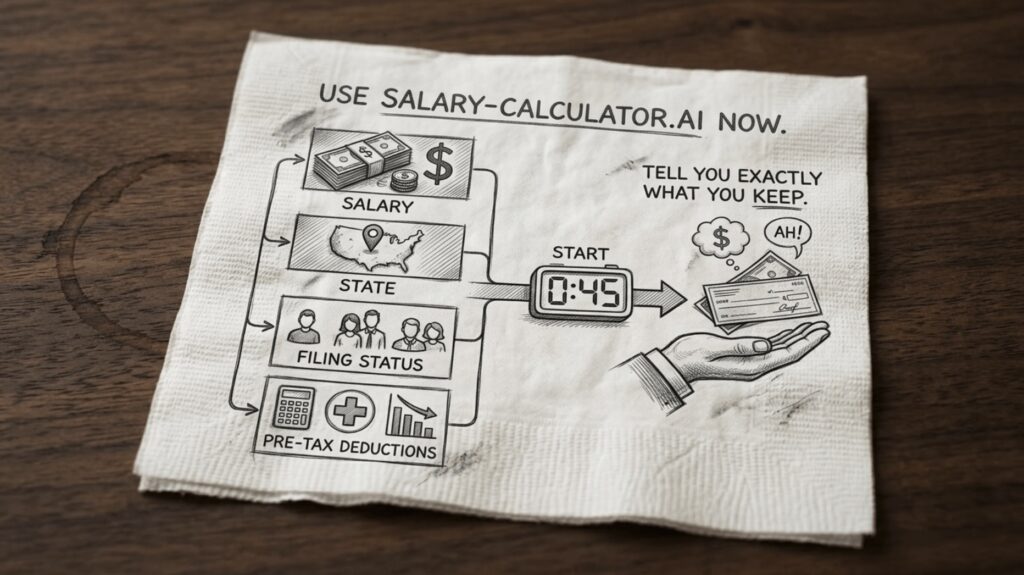
The majority of Americans plan their finances based on gross salary. Then their first paycheck comes—and their reality sets in. In 2026, the IRS has an income tax system of seven brackets of federal income tax of 10-37%, based on FICA taxes, state income tax, and whatever the pre-tax deductions your employer takes out before you can lay a dollar on the table. I had recently calculated the numbers for a California-based salary of $75,000. The actual take-home pay? Just over $52,000. A financial calculator pops up, which can calculate a good salary in less than a minute—without an accountant.
I genuinely believe that most people have a wildly inflated perception of their net pay. And the majority of paycheck tools on the web are designed to serve HR teams, rather than actual humans struggling to make rent.
Your Gross Salary Isn’t Your Salary
Your offer letter’s figure is made up. What you really retain is your net income—after the federal government, your state, and the Social Security Administration get theirs.
This is how your pocket’s gross income will appear by 2026, before being transformed into usable income:
- Federal income tax: Seven graded tax categories, 10% to 37%, based on the revised IRS 2026 tax bracket.
- Social Security tax: 6.2% on incomes up to the $176,100 wage base fixed by the Social Security Administration in 2026.
- Medicare tax: 1.45% basic; 2.35% when you make more than $200k (Additional Medicare Tax, according to IRS Publication 15)
- State income tax: 0% (Texas, Florida, Nevada) to 13.3% (the highest marginal tax rate of California)
- Pre-tax deductions: 401(k) savings, health premium deposits, and deposits made by employers reduce the amount you are taxed on—a step that most employees take advantage of.
You run all of your five, and you will find that the same $75,000 gross in New York only collects about $51,000-$54,000. In Texas, you’d clear around $57,000-$59,000. Same salary. Extremely disparate financial planning picture.
2026 Federal Income Tax Brackets – Single Filers
| Income Range | Tax Rate | Marginal or Effective? |
|---|---|---|
| $0 – $11,925 | 10% | Marginal |
| $11,926 – $48,475 | 12% | Marginal |
| $48,476 – $103,350 | 22% | Marginal |
| $103,351 – $197,300 | 24% | Marginal |
| $197,301 – $250,525 | 32% | Marginal |
| $250,526 – $626,350 | 35% | Marginal |
| Over $626,350 | 37% | Marginal |
Real Case: What $90,000 in Austin, Texas, Would Look Like after Taxes
Meet Everett, software project coordinator, gross, single filer, $90k, in Austin. He deposits 6% of his 401(k) and spends 200/month on pre-tax health insurance payments. He uses a paycheck calculator to compute his numbers.
A salary calculator gives the following result:
- Gross annual: $90,000
- 401(k) pre-tax (6%): -$5,400
- Health insurance (pretax): -$2,400
- Adjusted Gross Income (AGI): $82,200
- Estimated federal income tax: $13,800.
- FICA tax (Social Security + Medicare): Approx. $6,883.
- Texas state income tax: $0
- Estimated annual take-home: ~$61,517
That’s $5,126 a month in net pay. Everett could have budgeted on $7,500 without running the numbers, but this is a difference of $2,374 a month. That’s not a rounding error. That is a service bill, a grocery bill, and a utility bill lost.
What Makes a Real Salary Calculator Different From a Time-Wasting Waste?
I have tried at least 12 payroll tax calculators. The majority of them perform poorly on one or more important inputs. An acceptable tool in 2026 should be able to manage:
- US Income tax at the state level in the 50 states and Washington, D.C.
- Status of filed returns: single, married filing jointly, married filing separately, head of household
- Pre-tax deduction modeling 401(k), HSA, FSA, and employer benefits.
- Several pay periods: weekly, biweekly, semi-monthly, monthly, and annually.
- Supplemental wages — bonus withholding, overtime pay, equity vesting
Salary-calculator.ai takes care of it. That isn’t standard.
What Do the Experts Report About W-4 and Withholding Accuracy?
A warning of tens of millions of American workers inappropriately abusing their W-4 form has been raised by the Government Accountability Office (GAO) over the years, leading to an unexpected tax bill during the month of April or an enormous overtime payment that is considered an interest-free loan to the Treasury.
This has been highlighted by Certified Financial Planner Marguerita Cheng, the CEO of Blue Ocean Global Wealth and a contributor quoted in Forbes and Kiplinger, to underline this: workers ought to replicate their tax withholding and effective tax rate at a minimum once a year, particularly following an increase, change of residence or new residence, or change in filing status.
Best Practices When a Salary Calculator is Used in 2026
- Match your W-4 exactly. The amount you withheld actually is based on what you have filed, not just on whether you have been filing or not. Alter your W-4 following each of the major life or income changes. The IRS Tax Withholding Estimator is not at the bottom.
- Always model your state. In California, where your salary is $150,000, a move to Nevada with a salary of the same value will save you $15,000 or more in state income tax each year. Run both. Make the decision based on the numbers.
- Re-calculate your decision until you receive an offer. It will move you to $115k and appear as a $20k increase, though with federal tax and FICA, you only really gain about $12k-$14k.
Use salary-calculator.ai now. Provide salary, state, filing status, and pre-tax deductions. It will take 45 seconds and tell you exactly what you keep.