MiroFish leverages collective logic from thousands of decentralized, self-organized agents to achieve high-accuracy forecasting through emergent swarm behavior in simulated parallel worlds.
Introduction
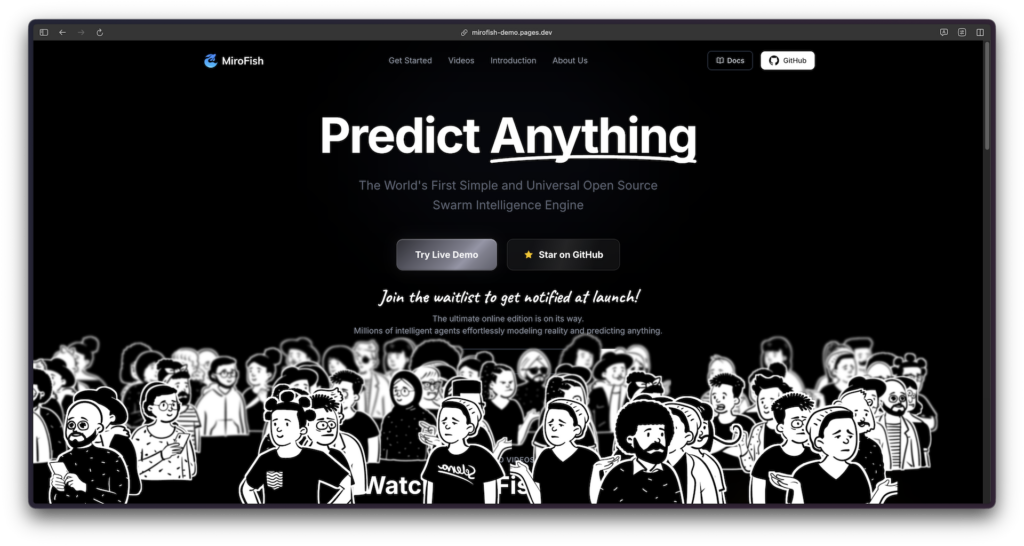
MiroFish stands as a next-generation swarm intelligence engine designed explicitly for predictive tasks across diverse domains. As a simple and universal swarm intelligence engine, it transforms raw seed information—such as breaking news, policy drafts, financial signals, or even narrative texts—into a high-fidelity parallel digital world. Within this environment, collective intelligence emerges naturally from the interactions of autonomous agents, mirroring the decentralized, self-organized systems that define swarm intelligence.
At its core, swarm intelligence draws from natural phenomena like schooling fish or flocking birds, where individual entities follow simple local rules yet produce sophisticated global outcomes without central control. MiroFish applies this principle universally: whether forecasting geopolitical outcomes, financial market shifts, public opinion dynamics, or the resolution of a literary plot, the engine enables precise predictions by letting collective behavior unfold organically. This universality distinguishes it from domain-specific tools, making MiroFish an essential open source predictive modeling resource for quantitative analysts and AI researchers seeking interpretable, collective-intelligence-based alternatives to conventional machine learning pipelines.
The engine’s design emphasizes accessibility and extensibility. Built as an open source project, it invites developers to explore, modify, and integrate the underlying multi-agent simulation logic into custom workflows, aligning perfectly with the needs of teams pursuing decentralized AI systems.
Core Mechanism
The technical logic of MiroFish centers on agent-based swarm simulation rather than traditional optimization algorithms. Seed data undergoes extraction and structuring via GraphRAG (Graph Retrieval-Augmented Generation), injecting individual and collective memories into a knowledge graph. This constructs the foundation for a parallel digital world populated by thousands of agents, each endowed with independent personalities, long-term memory stores, and behavioral logic derived from the input seeds.
Agents operate in a decentralized manner: no single controller dictates outcomes. Instead, they interact freely through social evolution protocols—conversing, updating temporal memories, and adapting to dynamically injected variables from a “God’s-eye” perspective. This process simulates collective emergence, analogous to fish schooling where local alignments yield global consensus. Over simulation rounds, agents explore scenario branches in parallel, refining predictions through iterative interactions.
The engine culminates in report generation via a specialized ReportAgent equipped with a rich toolset for deep post-simulation querying. Output manifests as a detailed forecast report synthesizing the swarm’s emergent consensus, alongside an interactive digital sandbox for further exploration. This mechanism ensures predictions remain traceable: analysts can replay agent dialogues or intervene mid-simulation, providing interpretability absent in many black-box systems. Parameters such as simulation depth (recommended under 40 rounds for initial testing due to computational load) and agent population scale influence the fidelity of collective intelligence outcomes, allowing fine-tuning for specific predictive modeling needs.
By relying on emergent swarm dynamics rather than gradient descent or fixed architectures, MiroFish excels in sparse-data or socially complex scenarios where traditional methods falter.
Prerequisites and Installation
Setting up MiroFish requires a hybrid environment to support its full-stack swarm intelligence engine. Begin by cloning the repository directly from GitHub to access the latest source.
git clone https://github.com/666ghj/MiroFish.git
cd MiroFish
Environment Prerequisites
- Node.js version 18 or higher (for frontend and orchestration)
- Python 3.11 to 3.12 (for backend simulation core)
- uv (latest version) as the Python package manager
Verify installations:
node -v
python --version
uv --version
Configuration
Copy and edit the environment template to include API credentials essential for LLM-driven agent interactions and memory persistence.
cp .env.example .envEdit .env with required values (example shown below; obtain keys from compatible providers):
# LLM API (OpenAI SDK compatible; Qwen-plus recommended)
LLM_API_KEY=your_api_key_here
LLM_BASE_URL=https://dashscope.aliyuncs.com/compatible-mode/v1
LLM_MODEL_NAME=qwen-plus

# Memory service (Zep Cloud free tier sufficient for testing)
ZEP_API_KEY=your_zep_api_key_here
Dependency Installation
Execute the one-click setup script for seamless integration of Node and Python components:
npm run setup:allAlternatively, install stepwise:
npm run setup          # Node dependencies (root + frontend)
npm run setup:backend  # Python dependencies with virtual environment
Launching the Engine
Start both frontend interface and backend swarm simulation service from the project root:
npm run devAccess points:
- Interactive web interface: http://localhost:3000
- Backend API: http://localhost:5001
For production-like deployment, Docker support is available via docker-compose up. This installation yields a fully operational swarm intelligence engine ready for collective intelligence prediction tasks, with all libraries managed automatically through the provided scripts.
Usage Guide
The standard “Predict Anything” workflow in MiroFish follows a streamlined, UI-driven process optimized for rapid collective intelligence prediction. Launch the local web interface and proceed as follows.
- Upload Seed Materials: Provide foundational data—PDF reports, text files, news clippings, or novel excerpts. The engine automatically parses and injects these into the GraphRAG structure.
- Configure Swarm Parameters: In the prediction interface, specify requirements via natural language (e.g., “Forecast public opinion shifts six months after policy implementation” or “Predict the lost ending of this literary work”). Optional advanced settings include simulation round limits (default under 40 for efficiency) and variable injection points for scenario testing. These parameters control agent population scale and interaction depth, directly influencing emergent consensus quality.
- Initiate Simulation: Trigger the dual-platform parallel run. Agents engage in social evolution, dynamically updating memories and exploring trajectories. Progress is visible in real time.
- Interpret Output Results: Receive two deliverables:
- A comprehensive prediction report synthesizing swarm consensus, complete with probability estimates, key divergence points, and supporting agent interaction logs.
- An interactive digital world sandbox allowing queries to individual agents or the ReportAgent for deeper validation.
Example Python script for programmatic access (via backend API, once services are running; extend for custom integrations):
import requests
import json

def mirofish_predict(seed_file_path, query_text):
    # Upload seed and submit prediction request
    with open(seed_file_path, 'rb') as f:
        files = {'seed': f}
        data = {'query': query_text, 'sim_rounds': 30}
        response = requests.post('http://localhost:5001/predict', files=files, data=data)

    if response.status_code == 200:
        result = response.json()
        print("Prediction Report:", result['report'])
        print("Interactive World ID:", result['world_id'])
        return result
    else:
        print("Error:", response.text)

# Usage
mirofish_predict('policy_draft.pdf', 'Predict economic impact in 12 months')
Results interpretation focuses on emergent metrics: consensus strength (derived from agent alignment), uncertainty bands, and traceable decision paths. This workflow supports iterative refinement, enabling quantitative analysts to validate open source predictive modeling outputs against real-world observations.
Comparison with Traditional Neural Networks
When contrasted with traditional neural networks, MiroFish offers distinct advantages in interpretability and suitability for complex predictive tasks. Neural networks function as opaque function approximators, training on labeled data to minimize loss through backpropagation; predictions emerge from millions of weighted connections without inherent explainability. In contrast, the swarm intelligence engine exposes every step: agent personalities, memory updates, and interaction transcripts allow full audit trails of how collective intelligence arrives at forecasts.
Efficiency considerations differ by context. Neural networks deliver fast inference post-training but require extensive datasets and retraining for new domains. MiroFish, while computationally intensive during simulation (due to per-agent LLM calls), proves more efficient for socially dynamic or low-data scenarios—leveraging decentralized self-organization to generate robust predictions without massive labeled corpora. This makes the engine particularly valuable for open source predictive modeling in policy analysis, finance, or narrative forecasting, where neural networks often underperform due to lack of causal transparency.
Developers report higher trust in MiroFish outputs precisely because swarm-derived consensus mimics real collective behavior, reducing the black-box risks prevalent in deep learning pipelines.
Advanced Optimization and Best Practices
To maximize performance within the MiroFish swarm intelligence engine, adopt targeted optimizations aligned with collective intelligence principles. Limit initial simulations to fewer than 40 rounds to manage LLM costs while establishing baseline accuracy. Scale agent populations incrementally, monitoring emergence metrics for diminishing returns. Leverage Docker containers for reproducible deployments across teams, ensuring consistent open source predictive modeling environments.
Integrate custom seed parsers or extend the ReportAgent toolset via backend Python modifications for domain-specific enhancements. For SEO and GEO visibility in research contexts, document workflows with keywords such as “swarm intelligence engine” and “collective intelligence prediction” in internal reports. Regular updates from the GitHub repository incorporate community-driven improvements, maintaining MiroFish at the forefront of decentralized AI systems.
In summary, MiroFish empowers users to harness swarm intelligence for universal forecasting. Its installation, usage, and mechanisms provide a complete, actionable framework for high-accuracy, interpretable predictions—solidifying its role as the premier open source tool for collective intelligence prediction and predictive modeling in modern AI workflows.