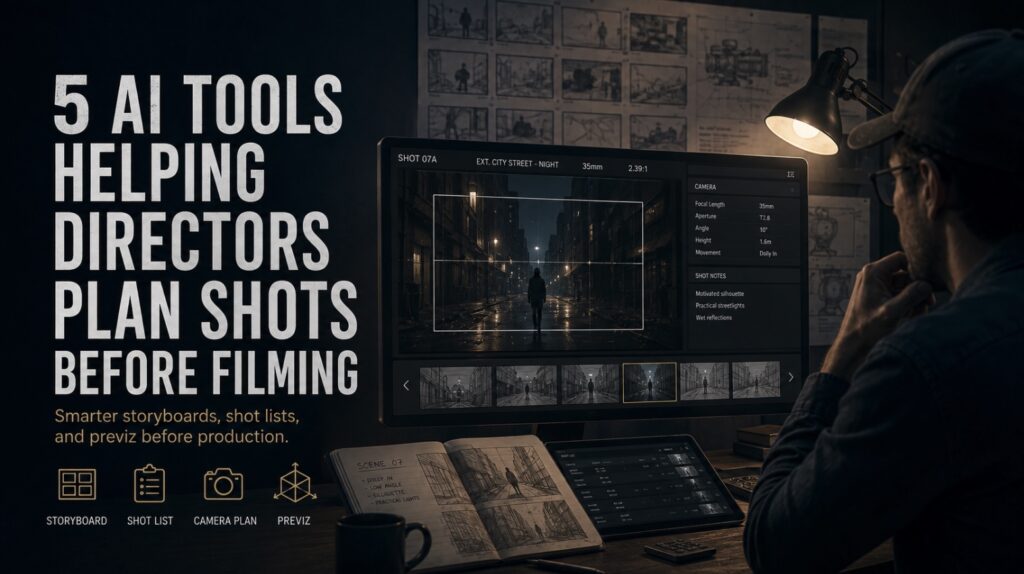
A scene can look convincing in a script and still fall apart during production. Unclear blocking, weak coverage, impractical camera moves, and shifting visual details can lead to rushed decisions on set. AI planning tools offer a faster way to turn written ideas into shot lists, storyboards, and moving previews before filming starts. This reflects the broader role of AI in modern entertainment, where creative technology is making it easier for more people to move from consuming stories to actively shaping and producing them.
Careful review remains essential. A 2026 physical realism benchmark found that 83.3% of exocentric AI-generated videos in physics critical scenes contained at least one human-identifiable glitch. The five tools below help directors visualize ideas early, compare approaches, and spot problems while changes are still easier to make.
The Best Tools at a Glance
The best AI shot planning tool depends on the size and needs of the production. Invideo Agent Two is suited to directors who want one project context for scripts, characters, locations, shot plans, and later production work. Katalist AI focuses on turning scripts into consistent storyboards and visual sequences. StoryboardHero helps teams create clear boards for reviews and approvals. Storyboarder.ai supports automatic storyboards, shot lists, screenplay development, and animatic previews. Filmustage connects visual planning with breakdowns, schedules, budgets, and locations.
For a short commercial, a focused storyboard platform may be enough. For a film, series, or complex campaign, project memory and shared production context become more valuable. Teams should also consider how easily plans can be shared and moved into editing. No platform removes the need for directors, cinematographers, editors, and assistant directors to check screen direction, lens choices, coverage, safety, and practical limits before filming.
How We Evaluated These AI Shot Planning Tools
We reviewed each platform using five practical questions:
- Can it turn a script or brief into useful visual plans?
- Does it support framing, blocking, camera movement, and revisions?
- Is it possible to keep the personalities and settings consistent among shots?
- Does it provide boards, shot lists, or animatics?
- Is the pricing practical for small production teams?
Previsualization helps crews find costly errors before production and may include storyboards, animatics, shot lists, photos, or 3D scenes.
Comparison Table
| Tool | Best for | Main outputs | Starting price |
|---|---|---|---|
| Invideo Agent Two | Full project planning with shared memory | Storyboards, shot plans, animatics, generated footage | Free plan available. $17 per month with annual billing |
| Katalist AI | Script-based visual planning | Storyboards, videos, voiceover, Premiere Pro export | $19 per month |
| StoryboardHero | Clear boards for reviews and approvals | Storyboards, PDF, online sharing, MP4 | $19 per month |
| Storyboarder.ai | Fast automatic planning | Shot lists, storyboards, screenplays, animatics | Free limited plan |
| Filmustage | Planning linked with production logistics | Breakdowns, boards, schedules, budgets | Free plan, AI plan from $49 per month |
*Prices were checked on August 4, 2026. Plans and regional rates may change.
1. Invideo Agent Two
Invideo Agent Two works as an AI filmmaking collaborator. Directors can place scripts, treatments, character sheets, references, locations, and creative rules inside one project context. Role-based agents can then support storyboarding, cinematography, casting, and other crew tasks while sharing the same knowledge.
Key features
- Persistent memory for characters, locations, costumes, and visual rules
- Script reading, scene briefs, shot lists, storyboards, and moving previz
- Specialist agents that share updates and project context
- Access to more than 200 media models
Best for: Films, series, microdramas, and brand films with connected shots.
Use cases: Blocking, camera planning, coverage tests, visual effects planning, and continuity checks.
Where it falls short: The broad workflow may feel excessive for someone who only needs a few static panels. Credit costs also vary by model and settings.
Pricing: A free plan is available. Paid plans are credit-based.
Directors can also remove video background with Key Lab. It is part of invideo’s VFX House, the same post-production toolkit used by filmmakers on the platform. It delivers precise, edge-accurate removal that holds up at full resolution, including through motion, hair, and shadows.
2. Katalist AI
Katalist AI focuses on moving from written scripts to storyboards and video concepts. Its AI Script Assistant, consistent character features, voiceover support, and image editing tools help directors build and revise a sequence without starting again after every change. Pro and higher plans also include Adobe Premiere Pro integration.
Key features
- AI Script Assistant for visual scene development
- Consistent characters across storyboard frames
- Image editing, voiceover, and video generation
- Adobe Premiere Pro integration on higher plans
Best for: Directors and agencies that want a focused script-to-storyboard workflow.
Use cases: Commercials, pitch films, music videos, short films, and pacing reviews.
Where it falls short: Essential limits users to five projects and one custom character. Larger productions may need a higher tier. It is less focused on schedules and production logistics than Filmustage.
Pricing: Essential costs $19 per month with 200 image credits and 700 video credits. Pro costs $39 per month, while Unlimited costs $99 per month. Each paid tier includes a seven-day trial.
Katalist AI is most useful when a team needs to turn a script into visuals that directors, clients, and editors can discuss before filming.
3. StoryboardHero
StoryboardHero is a focused platform for creating and sharing storyboards. It combines script development, AI images, online review, guest comments, and export options. Directors can build a sequence, share it with stakeholders, collect comments, and export the approved plan as a PDF or MP4 file.
Key features
- Unlimited concepts, scripts, boards, and frames on paid plans
- AI image generation with monthly premium image allowances
- Guest commenting and optional password protection
- PDF, online sharing, and MP4 export
Best for: Directors and agencies that need presentable boards for team or client review.
Use cases: Commercial pitches, branded videos, explainers, interviews, and approval rounds.
Where it falls short: It mainly supports boards and visual approval. Scheduling, budget planning, and advanced moving previz require other software. StoryboardHero also notes that AI images may struggle when a frame contains several actions.
Pricing: Solo costs $19 per month for one seat. Starter costs $59 for five seats, while Advanced costs $199 for ten seats. A seven-day free trial is available without a credit card.
StoryboardHero fits productions where a board must communicate camera intent clearly and move through feedback without unnecessary complexity.
4. Storyboarder.ai
Storyboarder.ai can turn a screenplay, concept, or written idea into a shot list, storyboard, screenplay, and animatic. Paid plans include unlimited image generation, while a separate video add-on turns storyboard frames into moving clips. Directors can create a fast first pass, revise individual images, and test whether the planned sequence has clear coverage and rhythm.
Key features
- Automatic storyboard, shot list, screenplay, and animatic generation
- Screenplay and PDF concept imports
- Unlimited image generation on paid plans
- Image-to-video options for testing movement
Best for: independent filmmakers and agencies that require a quick initial graphic strategy.
Use cases: Short films, commercials, pitch decks, coverage checks, and early animatics.
Where it falls short: Starter supports five projects per month and scripts of about ten pages. Video work beyond the included generations requires a paid add-on.
Pricing: The free plan includes two projects, nine shots per project, and 50 image generations. A temporary offer lists Starter at $27 per month through August 31, 2026, while the regular listed price is $69. Regional rates may vary.
Storyboarder.ai works best as a planning partner, not as a substitute for checking geography, performance intent, safety, and camera access.
5. Filmustage
Filmustage connects shot planning with the wider work of pre-production. It can hold scripts, breakdown elements, storyboards, shot lists, scene notes, schedules, locations, budgets, call sheets, and team comments. Its Director’s Cut plan adds AI breakdowns, scene analysis, storyboard images, smart scheduling, and an assistant that can act on production requests.
Key features
- Manual and AI-assisted script breakdowns
- Storyboards, shot lists, scene notes, and location planning
- Smart scheduling, budget support, and call sheets
- Team collaboration and professional exports
Best for: Directors and producers who need visual choices connected to production limits.
Use cases: Feature films, episodic work, location-heavy shoots, large casts, and visual effects scenes.
Where it falls short: Filmustage is not mainly designed for polished cinematic video previews. Teams may need another platform to test detailed camera movement, final lighting, or a finished look.
Pricing: The Free plan includes one active project, manual tools, and a partial AI breakdown. The Director’s Cut, which includes 1,000 coins per payment cycle for AI work, begins at $49 per month when billed annually.
Filmustage is the practical choice when a creative shot cannot be separated from the crew, location, time, and money needed to film it.
Which AI Shot Planning Tool Should You Choose?
Choose invideo Agent Two when project memory and continuity across a full sequence matter most. Katalist AI is a strong fit for fast script-based boards. StoryboardHero works well for polished boards and approval rounds. Storyboarder.ai suits teams that want automatic planning and optional animatics. Filmustage is best when the visual plan must connect with production logistics.
The right choice starts with the output your crew needs. A director preparing a client pitch has different needs from one planning an action scene or an episodic series.
Frequently Asked Questions
What is AI previsualization?
AI previsualization turns a script, scene description, or directing note into visual planning material before filming. Outputs may include storyboards, shot lists, camera notes, animatics, or rough video. It helps directors compare angles, test blocking, review pacing, and explain the intended scene before production.
Can AI replace a storyboard artist?
AI can speed up early exploration and create useful first drafts, but it does not replace an experienced storyboard artist. Artists understand performance, staging, visual rhythm, and practical limits. AI works best for trying options quickly while the director and visual team shape the final plan.
What should directors check in an AI storyboard?
Check screen direction, eyelines, character position, spatial continuity, camera height, shot size, movement, and edit coverage. Also look for changing props, costumes, faces, lighting, and background details. A visually attractive panel may still be impractical or incomplete as a filming guide.
Are animatics better than static storyboards?
Animatics are better for testing timing, dialogue length, movement, transitions, and sound cues. Static boards are faster for discussing composition, camera placement, and coverage. Many productions begin with boards and turn the approved sequence into an animatic after the main visual decisions are settled.
Which tool is best for keeping characters consistent?
Invideo Agent Two and Katalist AI both focus on character consistency across connected scenes. Its project memory holds character sheets, locations, costumes, and visual rules across shots and episodes. Katalist includes consistent character features across its paid plans.
Can AI create a final shot list?
AI can produce a solid starting point, but human evaluation is required for the final shot list. The director, cinematographer, assistant director, and producer must account for equipment, location access, light, performer schedules, safety, setup time, and editing needs.
Conclusion
AI shot planning tools can move directors from written ideas to visual decisions much faster. They make it easier to compare framing, test coverage, protect continuity, review pacing, and share a clear plan with the crew.
Start with one important scene and create two or three visual approaches. Review them with the cinematographer, editor, and production team before finalizing the shot list. Which part of planning shots would you most like AI to make easier?