 By
By How Modern Firewalls Are Evolving to Stop Advanced Cyber Threats
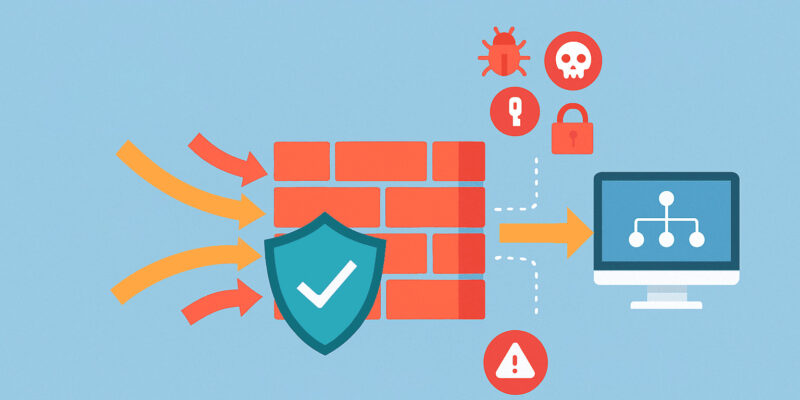
A firewall used to be a fairly simple gatekeeper: keep the bad stuff out, let the good stuff in, and maybe block a few sketchy ports while you’re at it. That idea still matters, but the reality of today’s threats has changed so much that “classic firewall thinking” doesn’t go far enough.
In 2026, attackers don’t need to smash through a front door. They can slip in through a compromised laptop on home Wi‑Fi, a cloud misconfiguration, a third-party SaaS integration, or a phishing link that leads to stolen session cookies. And once they’re in, they move quietly, living off the land, blending into legitimate traffic, and taking their time.
That’s why modern firewalls are evolving. They’re no longer just perimeter devices; they’re becoming smarter, more integrated, and more identity-aware because stopping advanced threats requires context, not just rules.
1) Firewalls are moving from “ports and protocols” to “applications and behavior.”
Traditional firewalls cared about IP addresses and ports. But attackers love hiding inside normal-looking traffic, especially HTTPS, which is basically the default for everything now.
Modern firewalls focus on the application and the behavior behind the traffic:
- Is this actually a browser request, or malware pretending to be one?
- Does this API call match normal patterns for this user or service?
- Is this device suddenly exfiltrating data at 3 a.m.?
This shift is one of the biggest reasons next-generation firewalls (NGFWs) became the norm. They inspect traffic more deeply and can enforce policies based on the real application, not just the connection details.
2) Encrypted traffic inspection is becoming non-negotiable
Here’s the awkward truth: most threats travel over encrypted channels now. If you can’t see inside encrypted traffic (at least in the places where it makes sense), you’re missing a lot of what’s happening.
So modern firewalls are getting better at TLS/SSL inspection while trying to balance performance and privacy. Many organizations now deploy selective decryption: inspecting high-risk categories and sensitive pathways (like outbound traffic from servers) while excluding personal banking or other clearly private destinations.
This isn’t always easy. It takes planning, certificate management, and clear policies. But the payoff is visibility; without it, advanced threats can remain undetected.
3) Identity is becoming the new perimeter
The “castle-and-moat” model broke when work left the office. Users connect from home, airports, phones, and unmanaged networks. Apps moved to SaaS and cloud. A single perimeter firewall can’t see (or control) everything anymore.
Modern firewalls are adapting by tying decisions to identity:
- Who is the user?
- Is the device managed and healthy?
- What is the user trying to access?
- Is this behaviour normal for their role?
Instead of “allow this IP range,” it becomes “allow authenticated finance users on compliant devices to reach finance systems.” That’s a big step toward Zero Trust thinking—and it’s why firewalls now integrate closely with identity providers, endpoint security, and device posture checks.
4) Firewalls are getting cloud-native and API-driven
A lot of “network traffic” isn’t in a physical office anymore; it’s east-west traffic inside cloud environments, between containers, services, and APIs. That traffic can be short-lived, dynamically routed, and scaled up and down automatically.
To keep up, firewalls are becoming the following:
- cloud-delivered (SSE/SASE approaches),
- virtualized for cloud networks,
- and more automated via APIs and infrastructure-as-code.
This matters because manual firewall rule changes don’t fit modern deployment cycles. Security teams need policies that can be version-controlled, tested, and rolled out in sync with app changes without becoming a bottleneck.
5) Threat intelligence and detection are getting built-in
Modern attackers reuse infrastructure, domains, and techniques. Firewalls are evolving by integrating threat intelligence and detection features directly into the platform:
- blocking known malicious domains,
- detecting command-and-control patterns,
- flagging suspicious DNS behavior,
- spotting unusual outbound connections.
The goal isn’t to replace dedicated EDR or SIEM tools but to make the firewall less “blind.” When it can recognize known bad patterns earlier, it can stop threats before they reach deeper parts of the environment.
6) Microsegmentation and lateral movement control are rising priorities
One of the biggest lessons from ransomware incidents is that the initial breach isn’t always the disaster. The disaster happens when attackers move laterally, jumping from one system to another until they find valuable data or high-privilege access.
Modern firewalls are evolving to support stronger segmentation:
- separating user networks from server networks,
- isolating critical systems,
- limiting what services can talk to each other,
- enforcing least-privilege connectivity.
It’s not glamorous work, but it’s incredibly effective. If an attacker compromises one device, segmentation can prevent that from becoming a full-scale incident.
7) Firewalls are becoming part of a broader security stack
The best firewall in the world won’t stop every threat by itself, especially not phishing, credential theft, or insider risk. That’s why modern firewalls are increasingly designed to plug into an ecosystem: endpoint protection, identity, cloud security posture management, and centralized monitoring.
This is where many companies start thinking in terms of network security solutions rather than “just a firewall.” The firewall is still important, but it’s one layer in a system that shares signals and responds together.
Closing thought
Modern firewalls are evolving because attackers evolved first. The old model static rules at a single perimeter don’t match how businesses operate or how threats move today. The new model is more context-aware: identity, encryption visibility, cloud integration, segmentation, and smarter detection.
If you’re upgrading your firewall strategy in 2026, the best question isn’t “How many gigabits can it handle?” It’s “Will it still protect us when users, apps, and threats don’t stay in one place anymore?”