 By
By Which AI in Healthcare Certificate Programs Fit Clinicians Moving Into Digital Health Leadership
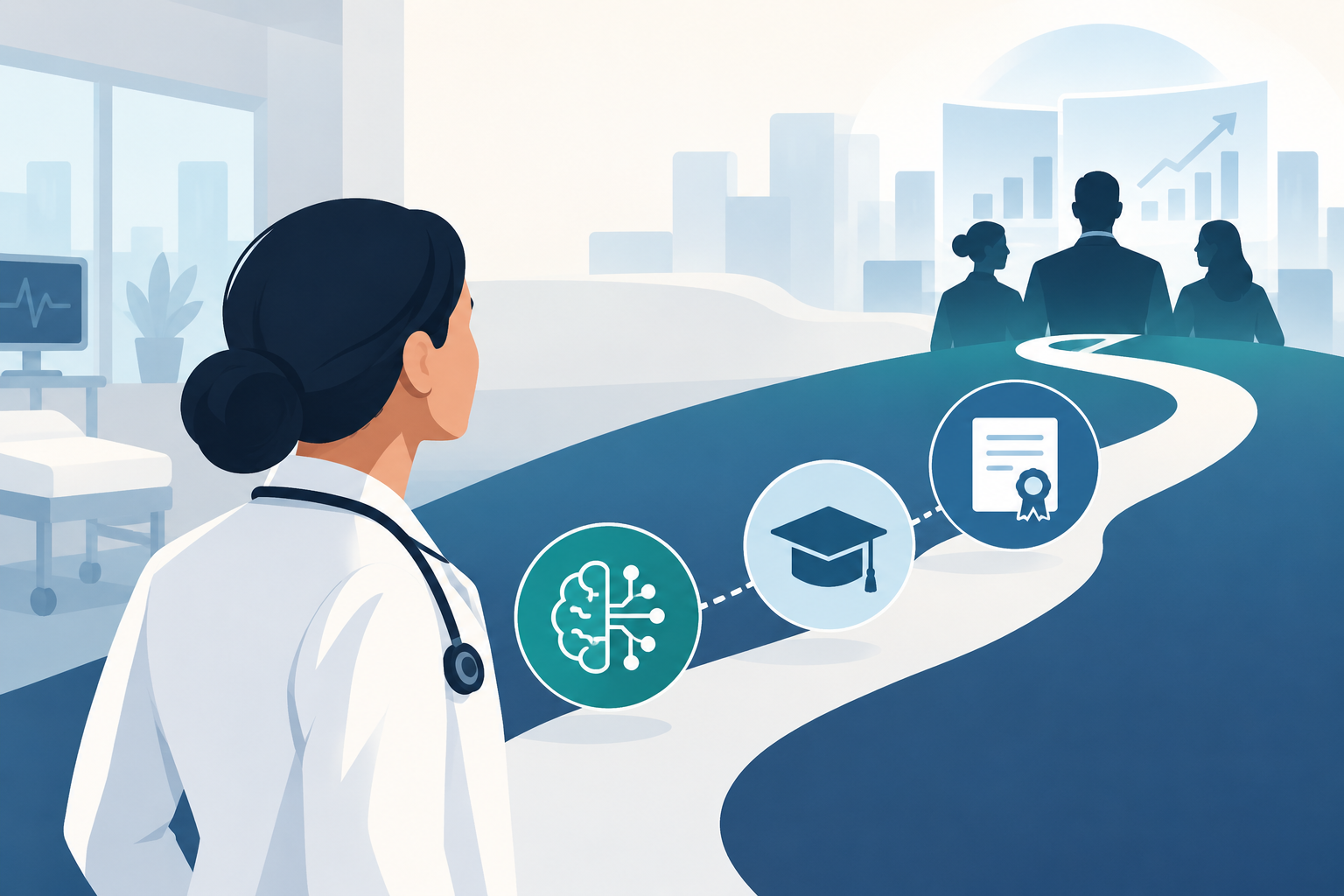
A move into digital health changes a clinician’s day-to-day responsibilities quite a bit. Instead of focusing only on care delivery, they may find themselves sitting in meetings about an AI recommendation, reviewing whether a prediction is safe enough to use, helping introduce a digital system, or questioning whether automation belongs in a particular clinical process at all.
That transition requires knowledge beyond AI terminology. Model evaluation, clinical decision support, healthcare data, governance, responsible AI, interoperability, change management, and human oversight all affect whether technology works safely in a real health system.
The programs here do not all prepare clinicians for the same kind of role. Most deal directly with healthcare AI, implementation, and digital-health leadership. Duke comes at the problem from another direction, adding deeper knowledge of nutrition and preventive care for clinicians whose work may involve wellness programs, chronic disease, or personalized-health services.
5 Healthcare AI and Digital Health Programs
| # | Program | Provider | Duration | Fee | Best Aligned With |
|---|---|---|---|---|---|
| 1 | AI and Agentic AI in Healthcare | Johns Hopkins University | 10 weeks | US$2,990 | Clinical AI adoption and leadership |
| 2 | AI in Healthcare Certificate | Cornell University | 2 months | US$3,750 | Healthcare data, ML and digital tool design |
| 3 | Certificate Program in Nutrition Strategies for Lifelong Health and Wellness | Duke University School of Medicine | 9 weeks | US$2,700 | Preventive health and evidence-based nutrition |
| 4 | AI in Healthcare Leadership and Strategy | Stanford Medicine | 4 weeks | US$9,800 regular | AI strategy, governance and implementation |
| 5 | Assessing and Implementing AI and ML in Healthcare | HIMSS | Approx. 10 hours | US$510nonmember/US$425 member | Responsible AI implementation |
1. AI and Agentic AI in Healthcare – Johns Hopkins University
This AI in Healthcare Course is designed for healthcare professionals who need to understand both AI capabilities and the organizational work required to implement it. No prior programming experience is required.
Delivery & Duration: Over 10 weeks, participants study online through recorded lessons, mentor-led sessions, faculty masterclasses, and a set of healthcare cases that place the concepts in realistic clinical situations.
Credentials: Finishing the required coursework leads to a Johns Hopkins University Certificate of Completion and 6 CEUs.
Program Highlights: Predictive analytics and clinical decision support sit alongside disease management, LLMs, Agentic AI, regulation, and Responsible AI. The program also introduces human oversight and uses the R.O.A.D. Management Framework when discussing how an AI initiative moves from idea to implementation.
Outcomes: Participants work through questions clinicians are likely to face in practice. Is this the right setting for the model? What should still require a person’s approval? How does the project fit the organization’s priorities? PHI, accountability, and the gradual move from manual work to AI-assisted workflows are considered as part of those decisions.
Why should you choose this course?
- Clinical implementation receives as much attention as AI concepts. Model performance, patient workflows, adoption, regulation, and organizational change are connected.
- The curriculum reflects emerging agentic healthcare. Clinicians examine how teams may move from completing tasks themselves to supervising AI-supported workflows.
2. AI in Healthcare Certificate – Cornell University
Cornell’s certificate is more technical than most of the options in this list. It may suit someone who already works around clinical informatics or is comfortable enough with Python and machine learning to spend time working directly with healthcare data. The learning moves between data preparation, predictive models, medical text, and the design of tools intended for real users.
Delivery & Duration: The course runs online for two months, with participants generally spending around 5 to 7 hours on it each week.
Credentials: Successful completion results in Cornell University’s AI in Healthcare Certificate.
Program Highlights: Coursework covers healthcare databases, SQL, clustering, machine learning, sepsis prediction, NLP, BERT, and GenAI evaluation. FHIR, privacy, usability testing, and the FAVES principles bring clinical integration and human factors into the same discussion.
Outcomes: Learners work with clinical datasets, build and assess ML models, examine medical text, and think about how AI tools may fit into EHR environments. Tool usability and the needs of clinicians and patients remain part of the technical work.
Why should you choose this course?
- It develops technical confidence with healthcare data. Working with SQL, Python, predictive models, NLP, and clinical datasets gives participants a closer look at the kinds of problems healthcare AI teams actually encounter.
- Human factors are not separated from the technical work. Fairness, usability, validity, safety, effectiveness, and workflow fit all influence whether a tool is worth using.
3. Certificate Program in Nutrition Strategies for Lifelong Health and Wellness – Duke University School of Medicine
This Nutrition Certificate Program does not teach AI. Its relevance comes from a different part of digital health: someone still has to judge whether the health recommendation produced by a wellness or chronic-care service is clinically sensible. That becomes especially important when technology is used for nutrition, metabolic health, preventive care, or personalized guidance.
Delivery & Duration: The nine-week online course mixes live mentoring with monthly faculty sessions, cases, and practical exercises.
Credentials: Participants receive a Duke University School of Medicine Certificate of Completion and digital badge. CME credits are also available.
Program Highlights: The content spans nutrient science, energy balance, gut health, the microbiome, nutrition across the lifespan, cardiometabolic risk, chronic disease prevention, healthy aging, GLP-1 therapies, and sustainable nutrition.
Outcomes: Participants apply the material to real nutrition decisions. They consider what different life stages require, build evidence-based meal approaches, review chronic-disease interventions, and make sense of newer therapies used in weight management.
Why should you choose this course?
- It strengthens the clinical judgment behind digital-health programs. Technology can deliver information efficiently, but someone still needs to decide whether the recommendation itself is medically credible.
- Its subject matter maps well to preventive and chronic-care services. Healthy aging, cardiometabolic risk, nutrition, and GLP-1 therapies are common areas for digital wellness and personalized-health products.
4. AI in Healthcare Leadership and Strategy: From Innovation to Implementation – Stanford Medicine
Stanford’s course is intended for healthcare professionals who may be asked to help take an AI project beyond the experimental stage. That could mean deciding whether a pilot is ready for wider use, identifying what has to change in a clinical workflow, or helping establish who is responsible for the technology once it goes live. Physicians, nurses, informaticians, operational leaders, and health-tech professionals are all part of the intended audience.
Delivery & Duration: The course lasts four weeks and uses a hybrid format, combining virtual learning with a two-day immersion at Stanford University.
Credentials: Completion leads to a certificate from Stanford Medicine’s Division of Computational Medicine, with CME credits available to eligible clinicians.
Program Highlights: Topics include healthcare AI evaluation, readiness for adoption, workflow integration, governance, ethics, equity, Responsible AI, implementation planning, and change management.
Outcomes: Much of the work happens before deployment rather than after it. Participants consider whether the organization is ready, what the workflow may need to look like, and who should remain accountable for the system. They also develop a personalized charter for evaluating and adopting AI.
Why should you choose this course?
- The focus is leadership rather than model development. Participants work on the decisions required to introduce AI safely into health organizations.
- Implementation frameworks are designed for immediate use. You can take governance, workflow integration, readiness, and change management back to current clinical environments.
5. Assessing and Implementing AI and ML in Healthcare – HIMSS
HIMSS is the shortest option on the list. It suits clinicians or healthcare managers who want a practical introduction to AI implementation without enrolling in a longer certificate. The emphasis is on the decisions surrounding an AI system, not on learning how to build the model itself.
Delivery & Duration: The material takes about 10 hours and can be completed at the participant’s own pace. HIMSS allows up to six months to finish it.
Credentials: Participants who complete the course receive a Certificate of Completion together with 10 HIMSS continuing education hours.
Program Highlights: The material introduces AI and ML fundamentals, the machine learning lifecycle, data harmonization, implementation approaches, ethics, governance, evaluation, and development of healthcare use cases.
Outcomes: Participants practise looking at a proposed use case from an implementation perspective. That includes asking what the trade-offs are, deciding what success should look like, and considering who needs to oversee the system as it moves from introduction to ongoing use.
Why should you choose this course?
- The short format concentrates on implementation decisions. It suits clinicians and health leaders who need structured AI literacy without extensive technical training.
- Lifecycle thinking helps with oversight. The course treats evaluation, deployment, ongoing management, ethics, and governance as connected parts of one implementation process.
Conclusion
Clinical leadership in digital health involves more than asking whether an AI model is accurate. A system may perform well in testing and still fail in practice because staff do not trust it, the workflow becomes harder, patient information is put at risk, or responsibility becomes unclear when something goes wrong.
That is why an AI in healthcare certificate can prepare people for very different jobs. One clinician may need to become more confident with healthcare data and model evaluation. Another may be preparing to lead adoption or governance. Someone working in preventive care may need deeper subject expertise instead. The useful program is the one that matches the decisions the clinician will actually be expected to make.