Opik: Open-Source LLM Observability for RAG Evaluation Frameworks and Self-Hosted LLM Tracing

Opik by Comet is the essential open-source infrastructure for moving LLM applications from experimental prototypes to reliable production systems.
Introduction
Large language models introduce a fundamental challenge in modern AI development: their black-box nature makes debugging, evaluation, and monitoring far more complex than traditional software. Opik, developed by Comet, addresses this directly as the observability layer for the LLM era. It delivers full-stack visibility across the entire development lifecycle—from local debugging with detailed traces to automated evaluation in CI/CD pipelines and real-time production monitoring.
Built as a fully open-source platform, Opik supports complex RAG systems and agentic workflows by logging every step of execution, scoring outputs against objective metrics, and surfacing actionable insights in production-ready dashboards. Whether teams require self-hosted LLM tracing for data sovereignty or cloud-hosted scalability, Opik removes the guesswork that typically plagues generative AI deployments. This guide walks through its capabilities, installation paths, and practical implementation to help AI developers, DevOps engineers, and data scientists achieve reliable, observable LLM applications.
Core Features Analysis
Tracing Capabilities for Bottleneck Identification
Opik’s tracing engine captures complete execution graphs of LLM calls, tool invocations, and agent steps. Each trace includes input prompts, model outputs, token counts, latency breakdowns, and metadata. This granularity reveals bottlenecks in multi-step chains or agent loops that traditional logging cannot expose.
Integrations with OpenAI, LangChain, LangGraph, LlamaIndex, and others allow automatic instrumentation without boilerplate. Developers annotate spans manually or via the Python SDK to attach custom feedback scores, turning raw traces into debuggable artifacts. In agentic workflows, Opik visualizes tool routing decisions and conversation threads, making it straightforward to monitor agentic workflows at scale.
Evaluation Framework with LLM-as-a-Judge and Heuristic Metrics
Manual inspection of LLM outputs does not scale. Opik’s evaluation framework automates quality assessment using both heuristic metrics and LLM-as-a-judge evaluators. Pre-built metrics cover hallucination detection, answer relevance, context precision, and faithfulness—critical for RAG evaluation frameworks.
Teams define experiments against curated datasets, run parallel evaluations across prompt variants or model versions, and track regression trends over time. Integration with pytest enables automated scoring inside CI pipelines, while custom metrics support domain-specific criteria. This structured approach replaces subjective reviews with reproducible, quantifiable results.
Dataset Management for Regression Testing
Opik treats datasets as first-class citizens for systematic testing. Users upload or generate evaluation sets directly in the platform, version them alongside prompts, and execute experiments that compare outputs across iterations. This capability supports regression testing when updating retrieval pipelines or agent logic, ensuring changes do not degrade performance on known edge cases. Combined with tracing and evaluation, dataset management closes the loop from prototype experimentation to production validation.
Installation and Setup
Opik offers two deployment paths to accommodate different operational requirements: a fully self-hosted Docker-based installation for complete control and a managed cloud version for rapid onboarding.
Self-Hosted Docker-Based Installation
For teams prioritizing data privacy or on-premises deployment, the self-hosted option deploys the entire stack locally or in private infrastructure. Begin by cloning the repository:
git clone https://github.com/comet-ml/opik.git
cd opik
Launch the platform using the provided script:
./opik.shThis command starts all required services via Docker Compose. Access the UI at http://localhost:5173 once containers are running. For production-scale deployments, switch to Kubernetes via the official Helm chart.
Configure the Python SDK to point to the local instance:
pip install opik
opik configure --use_local
Alternatively, within code:
import opik
opik.configure(use_local=True)
All traces and evaluations remain inside the local volume at ~/opik, preserving data across restarts.
Comet-Hosted Cloud Version
The cloud path requires no infrastructure management. Create a free account at comet.com, install the SDK, and authenticate:
pip install opik
opik configure
The interactive prompt collects the API key and default project name. Subsequent calls automatically route to the hosted backend, enabling immediate tracing and evaluation without server setup.
Practical Usage Guide
Hello World: Tracing an OpenAI Call
The fastest way to experience Opik involves wrapping an existing OpenAI client. Install dependencies and initialize tracing:
pip install opik openaiimport os
from openai import OpenAI
from opik.integrations.openai import track_openai
os.environ["OPIK_PROJECT_NAME"] = "hello-world-demo"
client = OpenAI()
tracked_client = track_openai(client)
prompt = "Write a two-sentence story about LLM observability."
completion = tracked_client.chat.completions.create(
model="gpt-3.5-turbo",
messages=[{"role": "user", "content": prompt}]
)
print(completion.choices[0].message.content)Every call appears instantly in the Opik UI with full context, latency, and token usage. Adding the @track decorator to wrapper functions creates nested spans for multi-step workflows.
Deeper Dive: RAG Evaluation Scenario
For realistic RAG systems, combine LangChain tracing with automated evaluation. First, instrument a retrieval-augmented chain:
from langchain_openai import ChatOpenAI
from langchain_core.prompts import ChatPromptTemplate
from opik.integrations.langchain import OpikTracer

opik_tracer = OpikTracer(project_name="rag-evaluation-demo")

llm = ChatOpenAI(model="gpt-4o-mini")
prompt = ChatPromptTemplate.from_messages([
    ("human", "Answer the question using only the provided context: {context}\n\nQuestion: {question}")
])
chain = prompt | llm

result = chain.invoke(
    {
        "context": "Paris is the capital of France and home to the Eiffel Tower.",
        "question": "What is the capital of France?"
    },
    config={"callbacks": [opik_tracer]}
)
Next, evaluate faithfulness using Opik’s built-in LLM-as-a-judge metric:
from opik.evaluation.metrics import Hallucination

metric = Hallucination()

score = metric.score(
    input="What is the capital of France?",
    output=result.content,
    context=["Paris is the capital of France and home to the Eiffel Tower."]
)

print(f"Faithfulness score: {score}")
For dataset-scale testing, upload a CSV of input-output-context triples to Opik, define an experiment, and run batch evaluation. Metrics such as Answer Relevance and Context Precision quantify relevancy automatically, providing regression baselines for iterative RAG improvements.
Dashboard and Monitoring
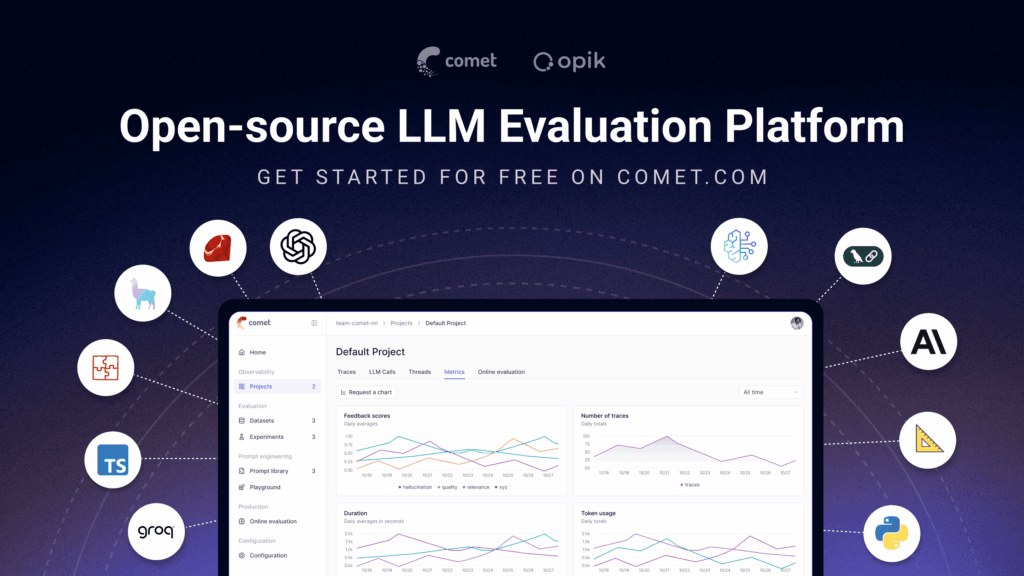
The Opik UI transforms raw traces into production intelligence. Interactive dashboards display latency distributions, average token consumption, and aggregated quality scores over daily or hourly windows. Feedback scores—logged manually or via online evaluation rules—appear alongside trace volumes, enabling quick identification of degrading performance.
Production teams configure LLM-as-a-judge rules that score incoming traces in real time, triggering alerts when faithfulness or relevance drops below thresholds. Searchable trace tables support annotation, comparison of prompt variants, and export for compliance audits. These capabilities ensure production stability by surfacing cost spikes, latency regressions, or quality drifts before they impact end users.
Opik stands out among LLM observability open source solutions by combining self-hosted LLM tracing flexibility with enterprise-grade evaluation depth. Compared to LangSmith, it delivers full open-source access without vendor lock-in and native support for diverse frameworks beyond the LangChain ecosystem. Teams building RAG evaluation frameworks or monitoring agentic workflows gain reproducible metrics, scalable tracing, and comprehensive dashboards in a single platform.
By integrating Opik early in the development cycle, organizations replace opaque LLM experiments with observable, measurable systems. Whether self-hosted for compliance or cloud-hosted for speed, the platform provides the infrastructure required to ship reliable generative AI applications at scale. Start with the quickstart examples above, instrument a production trace, and experience how structured observability accelerates iteration while safeguarding quality.