
Cognee: The Knowledge Engine for Deterministic AI Agent Memory in 6 Lines of Code

Key Takeaways
Cognee replaces unreliable vector retrieval with structured, graph-based deterministic memory for AI agents – implemented in just 6 lines of code to deliver consistent, traceable, and auditable long-term context that enables complex reasoning beyond simple semantic similarity.
Introduction
Defining the Memory Crisis in LLM Development
Modern LLM applications suffer from a fundamental memory crisis. Vector-based retrieval-augmented generation (RAG) has become the default for injecting external knowledge, yet it remains inherently probabilistic. Embeddings capture semantic similarity but lose explicit relationships, provenance, and structure. The result is hallucination-prone retrieval, brittle context windows, and agents that cannot reliably reason across interconnected facts or maintain persistent state across sessions. Developers building specialized agents – for codebases, enterprise documentation, or domain-specific workflows – repeatedly encounter the same limitations: non-deterministic outputs, exploding context costs, and the inability to trace how information was derived.
Cognee addresses this crisis directly as a dedicated Knowledge Engine. Instead of bolting another vector index onto an LLM, it constructs and maintains a living knowledge graph layered atop vector embeddings. This hybrid architecture moves AI agents from stateless prompt engineering to true long-term, structured memory. The core proposition is radical in its simplicity: give any agent deterministic memory in just 6 lines of code.
Why Vector RAG Falls Short and How Cognee Provides the Alternative
Traditional RAG excels at fuzzy lookup but fails at structural understanding. A query might surface relevant chunks yet miss transitive relationships or fail to disambiguate entities. Cognee solves this by transforming raw documents into a unified memory layer that combines semantic search with explicit graph traversal. The outcome is retrieval that is both conceptually relevant and logically connected – the foundation for reliable agentic reasoning.
The Philosophy of Cognee
From Unstructured Vector Blobs to Structured Knowledge Graphs
Cognee embodies a deliberate philosophical shift. Vector databases treat documents as opaque blobs of embeddings; relationships exist only implicitly through cosine similarity. Cognee inverts this model. Raw data is first chunked, then passed through LLM-driven cognitive processing that extracts entities, infers relationships, and generates summaries. The result is a property graph where nodes carry rich metadata and edges encode explicit semantics such as “converts_into” or “is_a”.
This graph is stored alongside vector embeddings and a relational provenance layer, creating three complementary stores: relational (document and chunk tracking), vector (semantic similarity), and graph (structural reasoning). The combination yields memory that is searchable by meaning and traversable by logic.
Deterministic Memory Versus Probabilistic Retrieval
Determinism is the distinguishing feature. Every piece of ingested data carries traceable lineage through the relational store. Graph construction follows reproducible LLM extraction pipelines, producing consistent entities and relationships on repeated runs. Queries return not just similar vectors but verifiable graph paths with provenance metadata. In contrast, pure vector RAG offers no such guarantees – the same query can surface different chunks depending on embedding drift or index updates.
This deterministic foundation enables auditability, reproducibility, and agent isolation, critical requirements for production AI infrastructure. Cognee does not hallucinate connections; it materializes them as first-class graph elements.
The 6-Line Implementation
The power of Cognee is most evident in its minimal API surface. The following example demonstrates the complete workflow for adding data, constructing the knowledge graph, and querying it:
import cognee
import asyncio

async def main():
    await cognee.add("Cognee turns documents into AI memory.")
    await cognee.cognify()
    results = await cognee.search("What does Cognee do?")
    for result in results:
        print(result)

if __name__ == "__main__":
    asyncio.run(main())
Breaking Down Each Line
- Import: Brings the Cognee SDK into scope. No complex configuration objects required.
- cognee.add(): Ingests raw data – strings, files, PDFs, or entire directories. The system automatically chunks content and stores provenance in the relational layer.
- cognee.cognify(): Triggers the core cognitive processing pipeline. An LLM extracts entities and relationships, builds the knowledge graph, generates summaries, and populates both vector and graph stores. This single call materializes the structured memory.
- cognee.search(): Executes a hybrid query combining vector similarity and graph traversal. Results include contextually enriched nodes with traceable edges.
- The remaining lines handle async orchestration and output – standard Python patterns.
Six operational lines replace thousands of lines of custom RAG orchestration, vector store management, and graph ETL code.
Technical Deep Dive
Architecture and Entity-Relationship Extraction
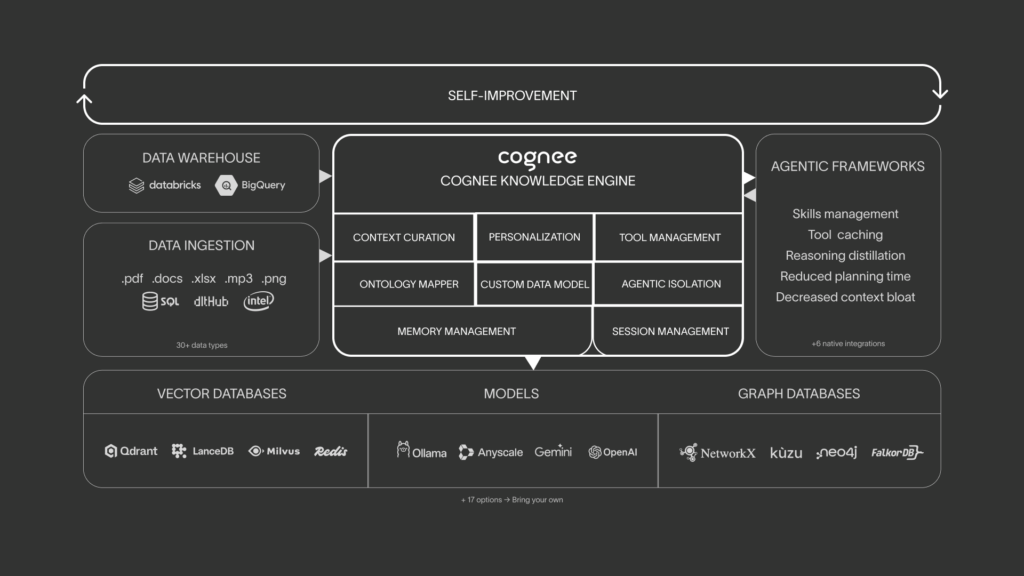
Cognee’s architecture consists of modular tasks and pipelines orchestrated around three storage backends. During cognify(), data passes through:
- Chunking and preprocessing.
- LLM-powered entity extraction and relationship inference using structured output backends (LiteLLM + Instructor or BAML).
- Graph construction where extracted concepts become nodes and inferred links become edges.
- Embedding generation for the vector store.
- Provenance recording in the relational store.
Entity extraction is ontology-grounded and multimodal, supporting text, code, and documents. Relationships are not guessed via similarity; they are explicitly asserted and stored as first-class graph elements.
Integration with LLMs and Vector Stores as Backends
Cognee is deliberately backend-agnostic. Supported LLM providers include OpenAI, Gemini, Anthropic, Ollama, Mistral, Groq, and custom vLLM endpoints. Embedding providers mirror this flexibility. Vector stores range from local LanceDB (default) to Qdrant, PGVector, ChromaDB, Redis, and cloud options. Graph databases include Kuzu (default), Neo4j, Memgraph, and Neptune.
Switching backends requires only environment variable changes and a one-time prune before re-cognification, preserving data consistency. This composability allows teams to start locally with zero infrastructure and scale to enterprise graph databases without rewriting application code.
The Concept of Cognitive Layers
Cognee implements memory as layered cognitive constructs. The base layer holds raw document chunks. The concept layer materializes extracted entities and summaries. The relationship layer encodes explicit edges. Optional memify() operations add derived layers – coding rules, synonym clusters, or task-specific abstractions. These layers evolve over time as new data arrives, enabling agents to reason at increasing levels of abstraction without manual prompt engineering.
Installation & Configuration
Step-by-Step Installation via Pip
Cognee installs cleanly into any modern Python environment (3.9–3.13):
pip install cogneeFor faster dependency resolution, the project recommends uv:
uv pip install cogneeProvider-specific extras are available:
pip install "cognee[gemini]" # or anthropic, ollama, etc.Environment Variable Setup
Create a .env file in your project root. The minimal configuration for OpenAI (default) is:
LLM_API_KEY="sk-..."For other providers, specify both LLM and embedding settings explicitly:
LLM_PROVIDER="gemini"
LLM_MODEL="gemini/gemini-flash-latest"
LLM_API_KEY="..."

EMBEDDING_PROVIDER="gemini"
EMBEDDING_MODEL="gemini/gemini-embedding-001"
EMBEDDING_API_KEY="..."
Vector and graph backends default to local LanceDB and Kuzu. Advanced users configure PGVector, Neo4j, or Qdrant via additional environment variables documented in the official setup guide.
First cognee.add() and cognee.cognify() Process
After installation and configuration, the workflow is:
- Import and (optionally) prune previous state for clean runs.
- Call
await cognee.add(data_source)– where data_source can be text, file paths, or directories. - Execute
await cognee.cognify()to trigger graph construction. - Query immediately with
await cognee.search(query).
No additional indexing scripts or schema definitions are required. The system handles chunking, extraction, embedding, and graph population transparently.
Advanced Usage
Handling Complex Datasets
Cognee scales naturally to production workloads. Pass PDFs, code repositories, or documentation folders directly to cognee.add(). The ingestion layer normalizes formats, while cognify() builds cross-document relationships automatically. For codebases, the graph captures function calls, module dependencies, and architectural patterns. Teams routinely ingest entire documentation sets or customer support tickets and query them with natural language across session boundaries.
Visualizing the Generated Knowledge Graph
After cognification, launch the built-in UI:
cognee-cli uiThis interactive interface renders the knowledge graph, allowing inspection of nodes, edges, and provenance. For programmatic visualization, export the graph via Cypher (Neo4j) or native Kuzu queries and render with NetworkX or Graphviz. The UI also exposes search results with highlighted relationship paths, making debugging and knowledge exploration trivial.
Conclusion
Structured knowledge is the missing prerequisite for AGI-like persistence in specialized agents. Vector RAG delivered the first wave of retrieval; Cognee delivers the second wave of deterministic, graph-native memory. By reducing long-term agent memory to six lines of code, it removes the infrastructure tax that has slowed AI application development for years.
Developers no longer need to choose between speed and reliability. With Cognee, agents gain persistent, auditable, and evolvable memory that grows with every document and interaction. The knowledge graph becomes the single source of truth – queryable, traversable, and explainable.
The repository is open source under Apache 2.0. Start building today at https://github.com/topoteretes/cognee and explore the full documentation at https://docs.cognee.ai. The memory crisis in LLM development ends here – replaced by a Knowledge Engine that finally makes AI agents reliable.