 By
By Paver Patios, Walkways & Driveways: The Complete Hardscaping Guide for Victoria BC Homes
Victoria’s mild, rain shadowed climate makes it one of the most rewarding places in Canada to invest in outdoor living space, but it also asks a lot of the materials sitting beneath your feet. Between soggy winters, dry summers, and the occasional cold snap that brings a freeze thaw cycle to the surface, a hardscaping project here has to be more than pretty. It has to be engineered for the ground it sits on.
Whether you’re planning a paver patio for evening entertaining, a walkway that curves through the garden, or a new driveway that can handle daily traffic, understanding the materials and methods available to you is the difference between a surface that lasts twenty years and one that needs rework within five. This guide walks through the current hardscaping trends in Victoria, compares the leading paving materials, shares design ideas for yards of every size, and explains how to tell when an existing patio or driveway needs attention. Any landscaper Victoria homeowners trust will tell you the same thing: the details underneath the surface matter just as much as what you see on top.
Hardscaping Trends in Victoria: Pavers, Flagstone, Gravel, and Concrete
Outdoor renovation in Greater Victoria has shifted noticeably over the past several years, and most of that shift comes down to drainage. Victoria receives well over 600 millimetres of rain annually, concentrated heavily in the fall and winter months, and a lot of that water has nowhere to go once it hits a sealed, sloped surface. Homeowners and contractors alike have responded by leaning into materials and layouts that let water pass through rather than run off.
Here’s a general look at the four most common hardscaping options homeowners are choosing between right now:
- Interlocking pavers: manufactured concrete or clay units laid in a pattern over a compacted base, with joints filled by sand. They’re the most requested option for patios, walkways, and driveways alike because of their flexibility and repairability.
- Flagstone: natural, irregularly shaped stone, often sandstone or slate, set either in a mortar bed or dry laid over gravel. Flagstone is prized for its organic, high end look.
- Gravel: crushed stone or decorative aggregate, typically used for driveways, informal pathways, or as a budget conscious alternative to solid paving.
- Poured concrete: a single monolithic slab, historically common for driveways but increasingly less popular for patios given how it performs against ground movement.
Each of these has a place in a well designed landscape, but they behave very differently once winter sets in.
Comparing Materials: Cost, Durability, Maintenance, and Best Use
Rather than treating every project the same, it helps to think about which material actually fits the job you have in mind. Below is a breakdown of how the major hardscaping materials stack up against one another.
Interlocking pavers Victoria homeowners install most often tend to sit in the mid range for upfront cost, but they offer some of the best long term value on the market. Because each unit is installed independently over a compacted aggregate base, individual pavers can be lifted and reset if the ground beneath them shifts, which keeps repair costs low over the life of the surface. Maintenance is straightforward: occasional resweeping of joint sand, periodic sealing, and the odd weed pull. Aesthetically, pavers come in dozens of colours, textures, and laying patterns, from herringbone to running bond to circular kits, so they suit both contemporary and traditional homes. They’re an excellent fit for patios, walkways, and driveways alike.
Flagstone patio installations cost more per square foot than pavers, largely due to the labour involved in fitting irregular, naturally cleft stones together. The payoff is a distinctive, timeless look that many homeowners feel pavers can’t fully replicate. Flagstone holds up well to weathering, but on a mortared base it can be prone to cracking during freeze thaw cycles if moisture gets trapped underneath, so dry laid installations over a well drained gravel bed tend to perform better in our climate. Flagstone is best reserved for patios, garden paths, and areas with lighter foot traffic rather than driveways.
Gravel driveway installation remains the most budget friendly option on this list, and it’s a practical choice for long rural driveways, utility paths, or as a transitional surface while other landscaping Victoria is completed. Gravel drains exceptionally well and is simple to top up when it settles, but it requires more upkeep than a fixed surface, including periodic raking, weed control, and replenishing lost material. It’s not the ideal choice where a polished, formal aesthetic is the goal, but for function and cost, it’s hard to beat.
Poured concrete offers a clean, uniform appearance and can be a reasonable choice for driveways with a heavy, consistent load. However, as a single rigid slab, it has no flexibility to accommodate soil movement. Once a crack forms, and in Victoria’s clay heavy winter soils, cracking is common, the repair options are limited to patching (which is rarely invisible) or full replacement.
Why Interlocking Pavers Thrive in the Pacific Northwest Climate
If there’s one material that keeps coming up in conversations about hardscaping ideas Victoria BC homeowners are pursuing, it’s interlocking pavers, and the climate is the reason why.
Victoria sits in a rain shadow, which gives it a mild, Mediterranean-like climate by Canadian standards. But mild doesn’t mean simple. The region still experiences a genuine freeze-thaw cycle each winter, and its clay-heavy soils expand and contract with moisture in a way that stresses rigid, monolithic surfaces. A poured concrete slab or heavily mortared patio has no give, so when the ground beneath it heaves even slightly, cracks appear and spread.
Interlocking pavers handle this movement far more gracefully. Because they’re installed as individual units over a compacted, well-drained base, small soil shifts are absorbed at the joints rather than transmitted across the entire surface. If a section does settle, it can be lifted, the base corrected, and the pavers reset, often without any visible sign of repair.
The other major advantage is permeability. A traditional sealed surface sheds rainwater across the top, often pooling in low spots or directing runoff toward the home’s foundation. A well built paver system, particularly one using open jointing and a properly graded aggregate base, allows water to filter down through the joints into the ground rather than running off. This reduces surface pooling, eases pressure on municipal storm drains during heavy rain events, and supports natural groundwater recharge, all of which matter in a region that sees the bulk of its precipitation compressed into a handful of months.
Hardscaping Ideas for Small and Large Backyards
Every property in Victoria is a little different, from tight, tree lined lots in older neighbourhoods to sprawling yards out toward Saanich and the Western Communities. The good news is that pavers and natural stone scale beautifully in either direction.
For smaller backyards:
- A tight patio footprint benefits from a single, consistent paver size and a simple running bond pattern, which visually stretches the space rather than breaking it up.
- Lighter, warmer paver tones reflect more light and can make an enclosed yard feel larger.
- A narrow paver walkway connecting a side gate to a back patio makes efficient use of otherwise unused space along a fence line.
- Built in seating walls using matching hardscape materials can double as a border without eating into usable square footage.
For larger backyards:
- Multiple connected zones, a dining patio near the house, a fire pit area further out, a walkway linking the two, create a more resort like flow and give the yard a sense of purpose in every corner.
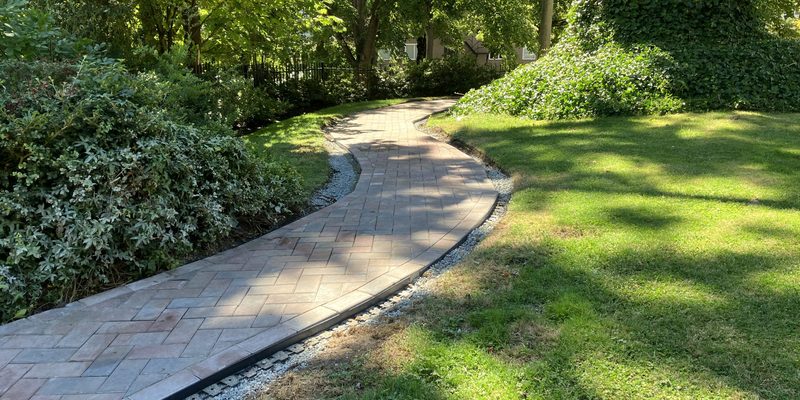
- A curved walkway rather than a straight path adds visual interest and slows the eye down as it moves through the garden, which tends to make a large space feel more intentional.
- Circular patios, often built using specialty paver kits designed for radial cuts, make a strong focal point for a fire pit, hot tub, or outdoor seating cluster.
- Mixing materials, flagstone stepping pads set into a lawn, or a paver patio framed by a gravel border, adds texture without requiring a full material change across the property.
Curved and circular layouts do add a bit more complexity to the install, since units near the edges of a curve need to be cut to fit, but a laying pattern like herringbone tends to accommodate curves more cleanly than a straight running bond.
How to Spot a Failing Paver Patio or Driveway
Even a well built hardscape needs occasional attention, and catching problems early almost always means a simpler, less expensive fix. Here are the signs worth watching for:
- Sinking or uneven sections. If part of your patio or driveway has dropped below the surrounding surface, or you notice water pooling in one spot after rain, the aggregate base beneath that area has likely settled or eroded. This is almost always a base issue rather than a problem with the pavers themselves.
- Weeds or moss between joints. A few weeds pushing through is usually a sign that the joint sand has washed out or broken down, not that the whole system is failing. Left unaddressed for a long stretch, though, root systems can begin to lift and shift individual units.
- Shifting or spreading pavers. If the outer edges of a patio or driveway are drifting outward, or units near the border no longer line up, it often points to a failed or missing edge restraint. Without that restraint holding the perimeter in place, everything inside it can slowly work its way loose.
- Cracked units. Occasional cracking in one or two pavers, often from a heavy impact or a vehicle load the surface wasn’t designed for, is a simple spot repair. Widespread cracking across many units at once usually signals a deeper base problem.
- Loose or wobbly pavers. If a paver rocks underfoot, the bedding material beneath it has likely washed away or compacted unevenly.
Repair or Replace?
The good news is that most paver problems fall into the repair category rather than requiring a full replacement. Because pavers are installed as individual units, a contractor can lift the affected section, correct the base, and reset the same pavers, often blending the repair in almost invisibly. Weed growth, joint sand loss, isolated sinking, and minor cracking are all typically resolved this way.
Full replacement tends to be reserved for situations where the base has failed broadly across the entire surface, where the original installation skipped proper compaction or base depth from the start, or where the pavers themselves have significantly faded, chipped, or cracked across most of the area. If you’re noticing several of these signs at once, particularly widespread sinking combined with poor drainage, it’s worth having a professional assess whether targeted paver repair Victoria services can extend the life of the existing installation before committing to a full rebuild.
Step by Step: How a Paver Patio, Walkway, or Driveway Is Installed
A finished paver surface looks simple, but the quality of the work happens almost entirely below what you can see. Here’s how a properly installed hardscape comes together:
- Excavation and subgrade preparation. The area is excavated to the appropriate depth for its intended use, deeper for a driveway than for a garden walkway, and the exposed soil is graded and compacted to create a stable, even subgrade.
- Base installation and compaction. A layer of crushed aggregate, typically several inches deep depending on the application, is spread and compacted in stages rather than all at once. This step is arguably the most important part of the entire process. A base that isn’t compacted properly in layers is one of the leading causes of sinking and shifting down the line.
- Bedding layer. A thin layer of coarse bedding sand or stone dust is screeded evenly over the compacted base. This layer allows individual pavers to be set at a consistent height while still permitting drainage.
- Edge restraints. Rigid or flexible edge restraints are installed along the perimeter of the project before the pavers go down. These hold the entire field in place and prevent the outward spreading that leads to long term shifting.
- Paver placement. Units are laid by hand in the chosen pattern, working from a fixed reference line to keep everything square and consistent. Cuts are made along borders and curves using a wet saw.
- Compaction of the surface. Once laid, the entire surface is compacted again with a plate compactor, which seats the pavers firmly into the bedding layer.
- Polymeric sand application. Fine polymeric sand is swept into the joints between pavers and lightly compacted, then activated with water. As it cures, it hardens into a firm, weather resistant joint that resists erosion and significantly reduces weed growth compared to standard sand.
- Final cleanup and sealing (optional). Excess sand is cleared from the surface, and depending on the material and the homeowner’s preference, a sealant may be applied to enhance colour and provide added protection against staining.
Skipping or rushing any one of these steps, particularly base compaction or edge restraints, is where most premature paver failures originate. It’s also why the labour and expertise behind an installation matter just as much as the materials themselves.
Bringing It All Together
A well planned hardscape does more than improve curb appeal. It manages water, adapts to the ground it’s built on, and holds up to daily use for decades when it’s installed correctly. Whether you’re leaning toward the flexibility of interlocking pavers, the natural character of flagstone, or the practicality of a gravel driveway, the right choice comes down to how the space will be used and how well the installation accounts for Victoria’s rain and seasonal ground movement.
Triton Landscaping works with homeowners across Victoria to plan, install, and repair paver patios, walkways, and driveways built for the realities of our local climate. If you’re ready to explore paver patio and walkway options for your own property, visit our service pages at tritonlandscaping.ca to see examples of past work and get started on your project.